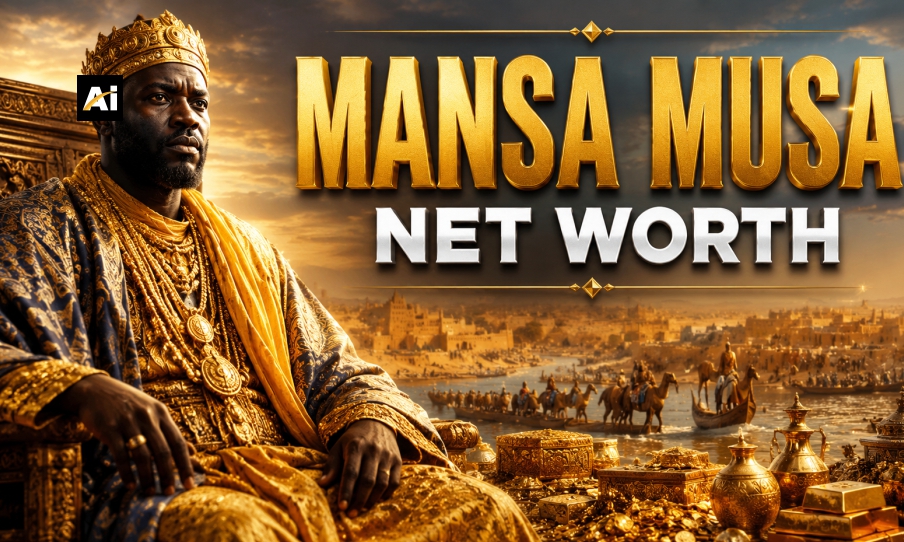
The history of riches is full of industrialists and modern-day billionaires. However, if one is to travel back in time and meet the richest person in history, according to many historians, he or she would have to head to 14th century West Africa. The name Mansa Musa Net Worth has become a real mystery to economists and historians. It has attracted their attention since they have long been trying to present an accurate estimation of the man’s wealth. While ruling the Mali Empire from 1312 to 1337, Mansa Musa controlled the largest gold reserves in the world. To comprehend how much wealth Mansa Musa Net Worth really has, it is essential to understand the processes that made him rich and the way his earnings impacted the economies of different countries.
The Natural Wealth of the Mali Empire
The main source of the fabulous Mansa Musa Net Worth was the natural wealth of the lands ruled by the king. Under Mansa Musa’s rule, the Mali Empire reached its peak and became the largest trading empire in the world. Gold and salt were the most valuable commodities in the Mali Empire. West Africa was the region where the majority of the world’s gold came from, and Mali produced more than fifty percent of the total gold. The gold deposits found in West Africa have been the king’s private property since Mansa Musa became the ruler of Mali. This explains why his net worth grew so high. All the gold that was mined belonged to him. It is also worth mentioning that the salt mines located in the Sahara Desert were highly profitable. Since their goods were considered to be among the most expensive and widely used ones in the world, they made Mansa Musa incredibly rich. Notably, the Mali king’s wealth came from two crucial sources: gold and salt. The latter was as valuable as the former because it could be used to preserve meat.
A Pilgrimage That Altered Global Economies
While European maps began to depict the West African ruler holding a massive gold coin, the rest of the world truly witnessed the staggering mansa musa net worth during his famous pilgrimage to Mecca in 1324. This journey was not merely a spiritual obligation fulfilled by a devout Muslim, but also an unprecedented display of sovereign wealth. The emperor traveled across the desert with an entourage that resembled a moving city, consisting of tens of thousands of soldiers, heralds, and attendants clothed in the finest Persian silks. Crucially, the caravan included dozens of camels each laden with hundreds of pounds of pure gold dust. As the procession moved through major metropolitan centers, the sheer volume of the mansa musa net worth became a tangible force. The ruler distributed gold so generously to the poor and spent it so lavishly in the markets of Cairo and Medina that he accidentally caused a massive currency crisis. By flooding the local markets with bullion, he depreciated the value of gold, inadvertently devastating the Middle Eastern economy and causing severe inflation that took over a decade to correct.
Translating Medieval Affluence into Modern Figures
Trying to calculate an exact contemporary figure for the mansa musa net worth is a notorious challenge for modern financial experts. Because the global financial system of the fourteenth century relied on vastly different mechanics than today, any exact number remains an educated estimate. However, when adjusted for modern inflation and compared against contemporary gross domestic product ratios, economic historians frequently place the mansa musa net worth at an astonishing four hundred billion dollars. This calculation comfortably positions him far ahead of historical industrialists like John D. Rockefeller and modern tech entrepreneurs. Some economists argue that even this multi-hundred-billion-dollar estimate is conservative, suggesting that his absolute control over global gold production effectively made his wealth immeasurable. When a single individual commands the primary resource used to back world currencies, standard net worth models begin to break down, leaving his fortune in a tier entirely of its own.
The Lasting Intellectual and Architectural Legacy
An accurate assessment of the mansa musa net worth extends far beyond the gold bars carried through the desert or the inflation caused in foreign markets. The true measure of his wealth is visible in how he chose to reinvest those resources into the infrastructure of his empire upon his return. Instead of hoarding his riches, the emperor utilized his immense capital to transform cities like Timbuktu and Gao into international centers of culture, religion, and academic learning. He commissioned legendary architects and Islamic scholars from Andalusia and Cairo, paying them handsomely in gold to construct sophisticated mosques, massive libraries, and highly advanced universities. The famous Djinguereber Mosque, which still stands proudly today, serves as a physical testament to the structural investments funded by the mansa musa net worth. This strategic allocation of capital turned the Mali Empire into an intellectual haven, attracting students and traders from across Africa and the Mediterranean, thereby securing a legacy of sophisticated civilization that outlasted the gold itself.
The Decline of an Economic Empire
The magnificent story of the mansa musa net worth eventually met a somber conclusion in the decades following his death. The immense wealth and centralized power that the emperor cultivated proved difficult for his successors to maintain. Without his formidable administrative capability and military leadership, the Mali Empire faced internal fractures, succession crises, and aggressive raids from neighboring states looking to seize the legendary gold fields. Over generations, the vast treasury was steadily depleted by civil conflict and the loss of key trading hubs, leading to the eventual fracturing of the empire. Despite the eventual dispersal of the physical gold, the historical record of the mansa musa net worth remains an essential study in global economics. It serves as a powerful reminder of a time when the undisputed center of global wealth and intellectual pursuit was located in the heart of West Africa, permanently etching the emperor’s name into the annals of financial history.