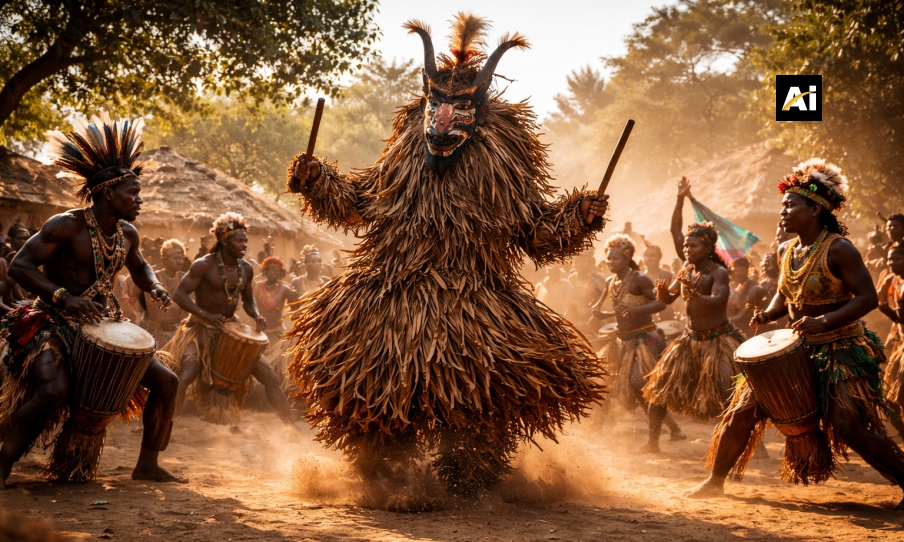
Out there where green stretches wide across southern Senegal and into Gambia, drums beat not only for joy but pull attention toward the unseen. From among masked figures central to Diola life, one stands apart – kumpo – not by name alone but shape, meaning, weight. Covered head to foot in swaying fronds, crowned with a slender carved rod, it walks as if roots and wind were joined. Seeing it move is like watching nature twist itself upright, taller than people expect, gliding despite its bulk. What looks stiff up close flows strangely fluid when set in motion, almost too quick to follow. It carries old voices without speaking, steps forward where others might hesitate, present yet distant. Not just decoration or ritual form, but a moment made visible – the past stepping through today. Even stillness becomes part of the performance once the body beneath begins to shift. Each turn hints at forces older than memory, guided by rhythms felt before thought arrives. The air changes slightly whenever it enters a clearing, though no word explains why.
The Sacred Roots and Tangible Form of the Mask
Who hides under those cracked palm leaves stays unknown – this truth tightly held across generations in parts of West Africa. Inside the village circle, no one says a living body wears the costume; instead, the kumpo moves as if breathing on its own, shaped by unseen forces. Built only with plants pulled fresh from wild thickets, the frame takes form slowly, carefully, almost like prayer made visible. Thin, rushlike threads drape downward so when spinning begins they fly outward, transforming the dancer into something wide, alive, circling like wind caught mid-storm. On top, a slender pole rises skyward – the ghost uses it somehow, perched impossibly still even while leaping over kneeling figures or skimming between houses without touching earth.
Social Guardianship and Enforcing Community Values
Not just dancing for show, the kumpo guides what feels right within the community. When big moments happen – like harvest time, coming-of-age rituals, or marriage – the people call it forth. Whistles rise, arms move in sharp signals, yet only one elder truly grasps their meaning. Through mimicry and posture, it teases anyone avoiding work, while lifting up those whose hands built something shared. Balance shifts quietly when it steps forward, never loud, always watched. Somehow, the mask holds things together, stitching Diola traditions into daily life by blending awe with reverence and shared celebration. Always there is this sense that those who came before are looking on – keeping everyone close, steady when the world pushes in.
The Art of the Spin and Rhythmic Communication
The technical skill required to animate the spirit is immense, involving a physical stamina that few possess. The signature move of the dance involves a rapid, hypnotic spinning motion that can last for several minutes without pause. As the kumpo rotates, the palm leaves create a distinct rustling sound that blends with the syncopated beats of the drums. This performance is a dialogue between the percussionists and the spirit; the drums dictate the intensity of the movement, while the spirit’s flourishes signal the musicians to shift their tempo. This interplay creates a high-energy atmosphere where the boundary between the spectators and the performer dissolves. Children watch with a mix of awe and trepidation, while the elders nod in approval, recognizing the continuation of a lineage that has survived centuries of colonial and modern influence.
Preserving a Living Heritage in a Changing World
In an era of rapid globalization and digital distraction, the survival of such a profound cultural practice is a testament to the strength of West African identity. The kumpo remains a vital part of the Casamance identity because it adapts to the times without losing its core mystery. While tourists may occasionally catch a glimpse of the dance, the true essence of the spirit remains internal to the village. It is not an artifact behind glass but a breathing, dancing entity that evolves with its people. The youth continue to take pride in learning the songs and the rhythms associated with the mask, ensuring that the rustle of the palm leaves will be heard by future generations. By maintaining the secrecy and the sanctity of the ritual, the community protects its soul, offering a space where the modern world fades away and the ancient spirits of the forest take center stage once more.
Reflections on the Eternal Rhythm of the Forest
As the sun sets over the baobab trees and the dust settled by the spinning spirit begins to clear, the village feels a renewed sense of order. The kumpo has done its work, leaving the people with a shared memory of wonder and a reinforced commitment to their neighbors. This isn’t just a performance; it is a reaffirmation of life. The spirit eventually retreats back into the shadows of the sacred grove, leaving behind only a few scattered palm fibers and a profound sense of peace. The drums may stop, but the energy of the dance lingers in the air, a quiet promise that as long as the drums beat and the people gather, the mystical protector of the Casamance will always return to guide them through the changing seasons of life.