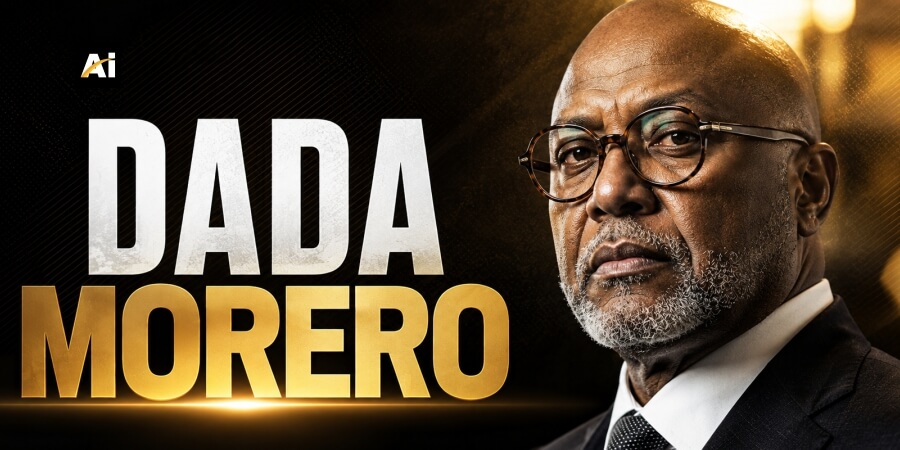
In the past it was mainly musicians, actors, athletes and social media influencers who could gain public notoriety. Nowadays anyone including politicians can have that reputation without actively pursuing it. Sometimes a soundbite from a speech posted on social media, a conflict recorded on camera or a hashtag can make a local politician notorious overnight. Dada Morero’s story shows an example of the change. There is no typical influencer story here; this is a case showing how increased visibility, attention from the media and reputation of the politician work together in a way that is difficult for political institutions to cope with.
Dada Morero has an entirely political track record and comes from politics rather than entertainment. He comes from Soweto and became active in student politics before joining the African National Congress. He was ANC Johannesburg regional secretary for two terms and was elected the chairperson in 2022. He served as mayor of Johannesburg for 25 days in late 2022 before being replaced by Mpho Phalatse. He came back as mayor in August 2024.
This trend is significant because it demonstrates that an online following is not always the first step toward digital prominence. The original platform can still be developed by traditional institutions. What transpires once a public figure garners notice has evolved. The public narrative can be shaped by audiences once speeches, debates, and political announcements become widely shareable content. Dada Morero has found himself working more and more in that setting, where the speed at which a political message spreads over social media channels is just as important as its policy content.
When Politics Becomes Shareable
The online fame economy is based on attention. In order to gain popularity, a content maker, a brand or politician does not need numerous followers. The moment the content starts being shared by other users, journalists and big accounts, it becomes valuable. Politically, communication is taking place in this very attention system.
In March 2025, there was a prominent example of Dada Morero, when the hashtag #JoburgServiceDelivery appeared on X. Some media claimed that it was likely that influencers had been used in the dissemination of the mayor’s message as many posts looked almost the same. The City of Johannesburg rejected these accusations, saying that none of the influencers had ever been employed or compensated.
Regardless of how the audience interpreted it, this incident revealed something significant. In the social media world, the presence of seemingly organized influence becomes a story on its own. There is no need to prove that there were paid actors for the discussion of the topic to start. Attention can become a separate entity from its original message.
The Value and Risk of Going Viral
For Dada Morero, visibility occasionally serves as a liability. Viral news can help gain attention for accomplishments, but it can also intensify the criticism. A leader who gets a few thousand impressions for a good announcement can get thousands of impressions in case of any scandalous alert document that is leaked.
One of the examples happened in April 2026 when a viral argument around the famous pothole in Johannesburg got viral after Helen Zille filmed herself addressing the problem. Morero reacted promptly making the public discussion an element of a larger debate on service delivery in the city. After the pothole was repaired, the issue gained even more significance remaining outside the traditional system of political communication.
It is at this point that the economics of attention complicated. Visibility may be beneficial as it makes a person or organization popular but negative attention may undermine the carefully crafted message. Social media provides the return more attractive for emotional content, for novelty, and for drama besides the content dealing with the city policy.
A Reputation Can Now Move Faster Than an Institution
The story of Dada Morero demonstrates that there is an increasing conflict between the institutional communication and the personal visibility. Traditionally, the government represents its views in press releases, official statements, and in scheduled media briefings while the social media platforms are quite different. A citizen can capture the situation and put it online to reach much wider audience before the government has prepared a response.
This situation became especially clear in August 2026 when a video with Morero fighting with a resident of Tshepisong, Soweto went viral. During the fight, the mayor used some obscene words after being referred to as a criminal. Meanwhile, he apologised afterwards. The situation was highly covered in media and the questions on his political future arose again.
This situation illustrates how people’s personal behavior and the image of the government become closer to each other. The mayor cannot think anymore that the verbal fight will remain a local problem.
What the Dada Morero Effect Really Reveals
For this reason, the real importance of Dada Morero is not in his celebrity per se, but in his role as a public figure whose influence is being transformed. His rise to fame took place in the context of activism, political party structures and local politics. Social media has not created his political status, but has definitely affected how this status is gathered by the public in the context of his influence.
Social media channels that have made it possible for mayors to promote their infrastructural programs can also cause a scandal that impacts the way people view politicians. For instance, the controversy about influence in 2025 exemplifies how questions about the online promotion could become an element of a politician’s publicity. The events of 2026 show the opposite situation: some instances of user-generated content could effectively outlive the politician’s communication strategy.
This may be the most fascinating phase of Cameron Diaz’s film career to yet. She returned to the film business at the right time, making films that showcased her professional abilities and connected to a whole new generation of actors and actresses.