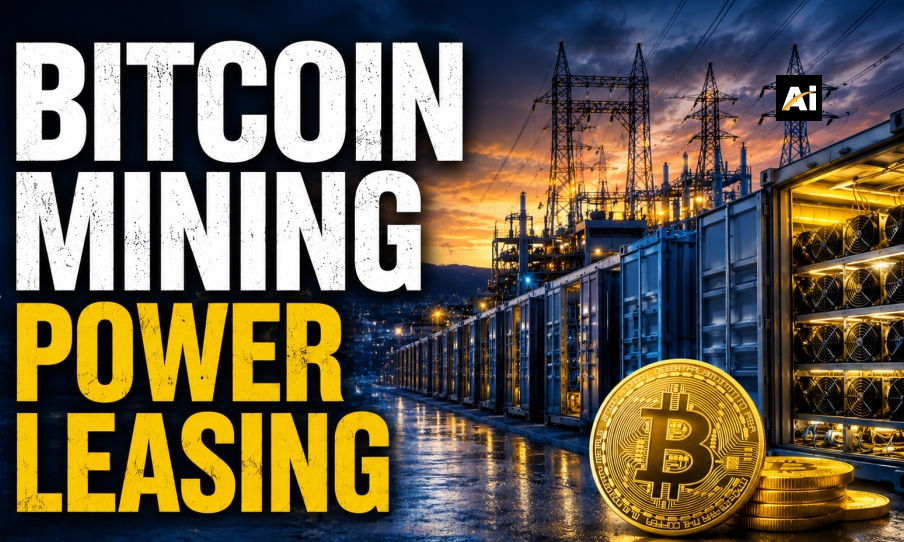
The realm of digital assets has evolved from the mere fun of enthusiasts to a serious competitive arena. At the beginning of cryptocurrency development, every person could contribute to the network’s safety and earn some coins as a reward. Now, the scene has changed dramatically, and a typical miner no longer is a solo operator. Now, the competition is severe, and those who want to succeed in mining must have substantial infrastructure, electricity, and high-tech equipment. However, not everyone can afford to invest significantly in mining facilities. For this reason, many people turn to bitcoin mining power leasing as an alternative to setting up a personal mining site. Such an approach is much easier since individuals rent specialized equipment and, thus, remove the need to deal with technical details.
More specifically, bitcoin mining power leasing allows a person to get a share of the total hashing power of a large-scale facility. One does not have to worry about the electricity supply, hardware maintenance, and other aspects. Instead, an individual can simply sign a contract with an operator, making payments in order to gain access to a share of the mining facilities. This approach effectively eliminates all the hassle of large-scale mining operations. It is highly convenient for those who lack the ability or desire to deal with all the technical aspects of crypto creation. Therefore, bitcoin mining power leasing is an easy way to participate in the proof-of-work mechanism and benefit from it. It is crucial to understand how such a system works and what possibilities it provides. After one grasps the fundamental principles, they can better navigate the industry.
The Core Mechanics of Renting Computational Energy
To grasp how these decentralized arrangements function, one must examine the contractual structures binding the provider and the lessee. When exploring how bitcoin mining power leasing operates in practice, the arrangement is governed by strict contract parameters. A user typically selects a plan from a remote provider, choosing a designated amount of hashing capacity measured in terahashes per second. This capacity represents the mathematical processing speed allocated to their account for a predetermined duration, which often spans anywhere from twelve to thirty-six months. Once the upfront fee is settled, the provider points that block of computational capacity toward a collective mining pool, where the combined efforts of thousands of machines work to solve cryptographic puzzles on the network.
Rewards generated from this collective computational effort are distributed back to participants proportionally based on their contracted share. Furthermore, the provider maintains the physical hardware, which means that bitcoin mining power leasing shifts the operational burden completely off the consumer’s shoulders. The facility handles everything from advanced cooling systems to physical security and real-time network optimizations. Payouts are deposited directly into the user’s digital wallet, providing a steady stream of asset distribution that mirrors the output of physical ownership without any localized headaches. This seamless operational flow relies heavily on the transparency of the provider, making it essential to monitor the real-time dashboards that track daily network performance and difficulty adjustments.
Weighing the Economic Benefits Against Structural Risks
Every financial endeavor carries a unique set of trade-offs that participants must analyze before committing capital. Evaluating the financial viability reveals that bitcoin mining power leasing eliminates massive upfront capital expenditures for ASIC machines. Instead of purchasing volatile hardware that may become obsolete within a few years due to rapid technological advancements, users can precisely budget their participation through fixed-term agreements. This shields the individual from the immediate downside of equipment depreciation and the logistical nightmare of selling used parts if they decide to exit the market. Additionally, these industrial facilities are frequently situated in geographic regions that feature cheap electricity or direct access to renewable energy sources, maximizing the raw efficiency of the rented output.
Despite these advantages, the remote model introduces specific structural vulnerabilities. However, market volatility and rising network difficulty mean that bitcoin mining power leasing does not guarantee automatic wealth, as maintenance fees can eat into daily payouts. Because daily rewards are tied to the fluctuating spot price of the underlying asset and the ever-climbing global network difficulty, a sudden market downturn can render fixed-fee contracts unprofitable. If daily operational costs deducted by the provider surpass the value of tokens generated, net returns quickly diminish. Moreover, the lack of physical asset ownership means that if a platform operates dishonestly or faces sudden insolvency, the user has very little recourse to reclaim their initial capital deployment, emphasizing the absolute necessity of rigorous platform vetting.
The Modern Pivot Toward Global Infrastructure Demands
The broader computational landscape is undergoing a massive transformation as the global thirst for raw energy reaches unprecedented heights. In the current economic climate, the utility of bitcoin mining power leasing has taken on a fascinating dual role across the tech sector. Many established digital asset facilities are discovering that their secured grid connections, massive electrical substations, and cooling systems are highly valuable to external industries. Instead of focusing solely on cryptocurrency extraction, these large-scale campuses are increasingly leasing out their high-voltage capacities to artificial intelligence firms and high-performance computing hyperscalers. This macro shift underlines the intrinsic value of energized land assets, proving that secured power infrastructure is one of the most precious commodities of the digital era.
This evolving synergy between traditional cryptographic extraction and modern artificial intelligence workloads highlights the fluid nature of modern data management. Whether an individual chooses bitcoin mining power leasing for asset generation or facilities pivot to high-performance computing, the underlying value of energized capacity remains undeniable. As the industry advances, the intersection of energy acquisition and raw computation will continue to dictate market winners. For the individual participant, renting operational capacity bridges the gap between complex blockchain protocols and accessible financial participation. By staying informed on network dynamics and choosing reputable infrastructure partners, participants can effectively harness the power of industrial data centers while letting the experts handle the operational heavy lifting.