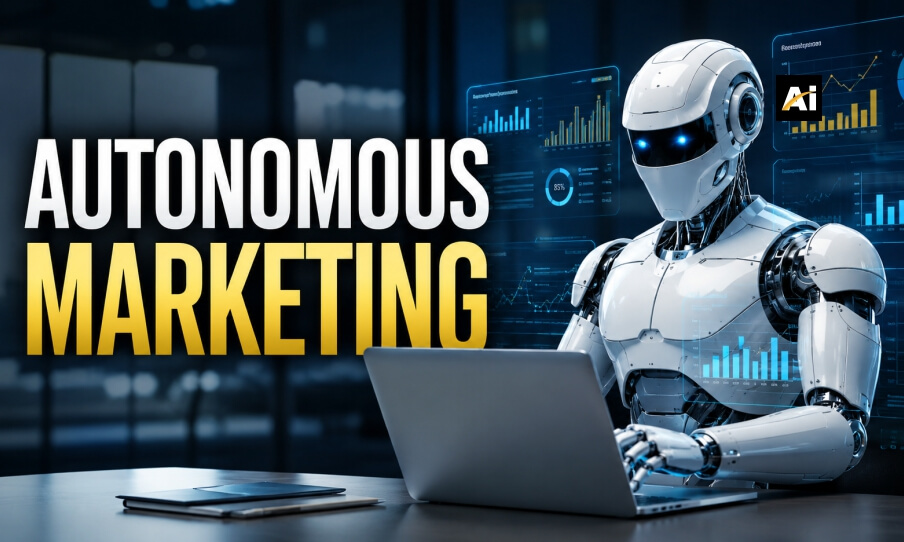
Marketing is entering a new phase as artificial intelligence moves beyond analytics, automation, and content assistance toward systems capable of interpreting signals, making decisions, executing actions, and continuously optimizing campaigns. This evolution is giving rise to Autonomous Marketing, an approach in which AI-powered systems can coordinate increasingly complex marketing activities with greater speed, adaptability, and precision. Rather than simply automating individual tasks, autonomous marketing connects data, intelligence, decision-making, and execution into more responsive growth systems.
As customer journeys get more scattered across search, social platforms, sites, marketplaces, email, mobile apps, and these newer AI interfaces, the usual marketing models can sometimes feel a bit slow, like they can’t quite keep up.
Autonomous Marketing offers a different approach: it lets organizations ingest real-time signals, spot opportunities as they arise, tailor interactions on the fly, sharpen campaigns, and shift resources dynamically without the usual delays.
Autonomous Marketing Is Redefining Modern Growth
Traditional marketing automation usually sticks to predefined rules, and it runs through set workflows, kind of rigidly. Autonomous marketing, on the other hand, brings more intelligence because it can sense changing conditions and decide what to do next, as long as the goals and constraints are still respected.
That difference makes Autonomous Marketing more relevant lately, especially for organizations trying to scale growth without everything becoming painfully manual. With AI-powered systems, the setup can keep checking things like campaign outcomes, how customers behave, what market signals are doing, and how it all lines up with business objectives, then surface opportunities for optimization, not just repeat the same play.
So, you get a marketing function that can react to change rather than merely follow predetermined instructions every time.
AI Intelligence Is Strengthening Marketing Decisions
Marketing teams generate enormous amounts of data, kind of through customer interactions, campaign activity, website behavior, sales pipelines, and various digital platforms. With AI, those signals can be chewed up at a scale and speed that the old-school analysis can’t really keep up with, not in the same way.
Then intelligent systems can spot patterns, predict customer behavior, segment audiences, assess campaign performance, and even nudge recommendations for what happens next. So, marketers end up making faster and more informed decisions while spending less time manually interpreting all that information, you know.
Overall, better intelligence leads to more responsive marketing strategies, and the whole thing just feels more adaptive.
Real-Time Optimization Improves Campaign Performance
Customer behavior can change really quickly, so any static campaign plan gets hard to keep up with, sooner or later. Autonomous systems can, more or less, keep an eye on performance all the time and then nudge the targeting, messaging, schedule, channel allocation, and a bunch of other campaign elements, depending on the preset objectives.
That ends up forming a feedback loop, where the campaigns learn from what happens afterward and keep getting better over time. Instead of sitting around waiting on those periodic performance check-ins, marketing teams can react to the shifting situation in a more flexible manner
This idea of continuous optimization drives greater marketing agility, almost as if it adapts on its own.
Personalization Becomes More Scalable
Consumers are now, more or less, expecting brands to grasp their personal needs and deliver relevant, mostly tailored, experiences. With AI, marketers can dig into behavioral and contextual signals and then personalize content, suggestions, offers, and messages—all at once and usually at scale.
Autonomous Marketing can help keep those experiences aligned across a handful of channels, while still staying consistent with the bigger brand goals and the customer strategy. So personalization becomes less reliant on manually built segments and more about reacting to real-time signals from the customer, right when it matters.
When the personalization is scalable, it opens up better chances for engagement and conversion, too.
Autonomous Systems Connect the Customer Journey
Modern customer journeys don’t really follow a straight line. A prospect might run into a brand via search, get pulled in through social media, hit a website, chat with an AI assistant, talk with sales, and then come back through some other channel before deciding.
AI-powered marketing systems can stitch together those signals across all that noise, so you get a fresher, more unified read on customer intent. Then organizations can sync their messaging and customer experience across channels, rather than treating each touchpoint as isolated.
With connected intelligence, you end up with a more coherent journey, and yeah, it feels a bit more continuous overall.
Human Strategy Remains Essential
Autonomous marketing doesn’t exactly remove the need for marketers; more like it shifts what humans do and where their know-how matters most. It’s kind of a replacement thing, but not fully, you know? Like, the AI can handle the routine parts, and humans still handle the important decisions—the parts where “what should we say” and “why” actually count.
Marketing professionals still own the core stuff—brand strategy, brand positioning, creative direction, ethical boundaries, real customer understanding, and the business objectives that keep everything aligned. The systems can run campaigns, improve targeting, and optimize performance within those boundaries. But it’s people who bring judgment and empathy, plus imagination and the strategic context that a machine won’t really feel.
So, the future of marketing is a mix: machine intelligence on one side, human leadership on the other. Together, it works better.
Responsible AI Protects Brand Trust
Greater autonomy also creates greater responsibility. Organizations must establish clear governance for data privacy, customer consent, algorithmic decision-making, brand safety, security, and regulatory compliance.
Marketing systems should operate within set limits and require appropriate human oversight for high-impact decisions. At the same time, transparency and accountability are essential to ensure AI-driven personalization remains trustworthy.
When autonomy is handled responsibly, it builds a sustainable marketing advantage.
Data Architecture Enables Autonomous Growth
Autonomous systems, really they need dependable data. When information is splintered, slightly off, or poorly governed, it can trip up AI-driven decisions. And then you get these inconsistent customer experiences, like nobody actually sees the same thing twice.
So organizations end up needing integrated data environments that tie together customer details, campaign performance, sales activity, product data, and other related signals. Good data governance then becomes the base layer that lets the AI work smoothly and helps systems make smarter decisions.
In short, high-quality data is the infrastructure behind autonomous marketing, and honestly, without it, the whole thing gets wobbly.
From Campaign Automation to Adaptive Growth Systems
The biggest shift is that marketing is moving from standalone campaign automation toward a connected growth system, sort of. These systems can monitor market signals, interpret customer behavior, suggest or execute actions, then assess outcomes and continuously improve over time.
With this model, organizations can scale marketing operations without just piling on more manual work. Instead of treating intelligence as a separate layer, it is built into the operating model, so marketing teams respond faster, while human focus shifts to higher-value strategic priorities.
Autonomous marketing turns marketing from a chain of campaigns into a continually learning growth engine.
Conclusion: Building the Future of Intelligent Marketing
The future of marketing will increasingly rely on blending artificial intelligence with real-time data, automation, personalization, and human strategy. Teams that manage to set up these abilities will be able to run marketing operations that respond more quickly, learn non-stop, and scale more effectively.
Autonomous Marketing is a significant step forward in how companies approach growth. When you connect intelligent decision-making with automated action and continuous refinement, you can end up with experiences that feel more adaptable for customers, along with growth strategies that react faster.
The “winners” won’t be the ones who remove people from marketing, though. It will be those who equip their teams with intelligent systems that extend human creativity, accelerate decision timelines, and turn shifting market signals into steady, sustainable opportunities.