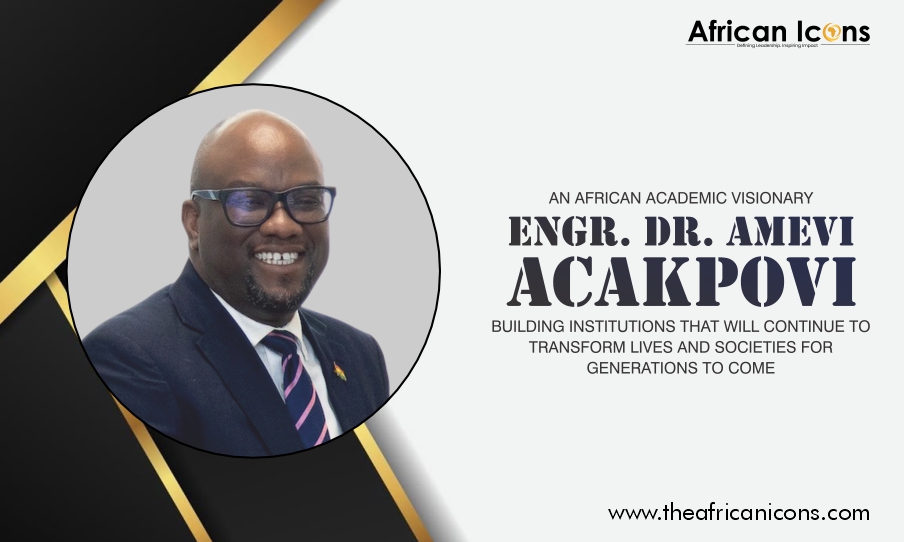
As the technology has changed everything in its wake, including education, we need an extraordinary vision to shape that change into a positive direction. Simply, we need transformational leadership. Specifically, in the African continent, when one searches for such a leader, Engr. Dr. Amevi Acakpovi emerges as a legend. Along with being the Vice-Chancellor at Accra Technical University (ATU), Ghana, Engr. Dr. Amevi Acakpovi is also the Elected President of the International Electrotechnical Commission (IEC) Ghana Chapter, a Consultant to the Ghana Standard Authority for the review of Electrotechnical Standards, and has been the elected president of the Technical Committee 77 from 2020 to 2026, on Electromagnetic Compatibility (EMC) that reports to the African Electrotechnical Standardization Commission (AFSEC), a branch of African Union.
A Golden Chapter
Engr. Dr. Amevi Acakpovi’s appointment as the VC at ATU marks a defining chapter in his academic leadership journey. In this position, his vision is to position Accra Technical University (ATU) as a leading institution in Africa that delivers industry-relevant education, applied research, and technology-driven innovation. “We are guided by a renewed institutional aspiration: to be the preferred Technical University in Africa for Industry Impact, Emerging Technologies, and Sustainability.”
Africa’s development depends heavily on how effectively we transform our educational systems into engines of skills development, entrepreneurship, and industrial transformation. ATU’s strategy, therefore, focuses on competency-based training, digital transformation, strong industry partnerships, and sustainability-oriented innovation.
Engr. Dr. Amevi Acakpovi adds that their goal is to ensure that every graduate leaving ATU is not only academically competent but also industry-ready, entrepreneurial, and capable of solving real-world challenges. “This means embedding practical training, work-based learning, and emerging technologies into every aspect of our academic ecosystem.”
Bridging the Traditional Divide
Technical and vocational education is critical to Africa’s growth. Yet, Engr. Dr. Amevi Acakpovi observes that the traditional divide between academic knowledge and practical industry needs is one of the greatest challenges facing higher education in Africa. Technical universities are uniquely positioned to bridge this gap.
At ATU, they address this challenge through competency-based training and strong industry integration. Their curricula are developed with direct input from industry stakeholders through Programme Advisory Committees and collaborative curriculum reviews. “This ensures that what we teach reflects the evolving demands of the labour market.”
Engr. Dr. Amevi Acakpovi adds that they also promote work-based learning models, including internships, industrial attachments, and project-based learning. Students work on real industry problems, engage with practitioners, and gain hands-on experience before graduation.
Furthermore, they encourage industry experts to participate in teaching and mentorship programmes. By creating an ecosystem where industry and academia interact continuously, universities can produce graduates who are ready to contribute immediately to economic development, he believes.
Balancing Three Pillars
As an academic leader, Engr. Dr. Amevi Acakpovi says that balancing the three pillars of research excellence, teaching quality, and administrative governance without compromising any one of them requires clarity of institutional priorities and strong governance structures.
First, teaching must remain at the core of the university’s mission. However, teaching excellence must be informed by research and innovation. Research allows universities to remain intellectually relevant and contribute solutions to societal challenges.
At ATU, they encourage applied research that directly addresses industry needs and national development priorities. Their research policies promote innovation, technology transfer, and collaboration with external partners.
Second, governance must create an enabling environment for both teaching and research. Transparent decision-making, effective policy frameworks, and performance monitoring systems ensure that academic goals are translated into institutional outcomes.
Ultimately, Engr. Dr. Amevi Acakpovi’s leadership philosophy is that teaching, research, and governance are not competing priorities—they are mutually reinforcing pillars of a thriving university.
Aligning Universities with the National Goal
He also contributes to national policy through technical committees. He feels that the alignment between universities and national development strategies is absolutely essential.
Higher education institutions cannot operate in isolation from the socio-economic priorities of their countries. Universities must contribute directly to national development goals, industrialization strategies, and workforce development.
ATU’s strategic direction aligns with global and national frameworks, including the Sustainable Development Goals (SDGs), the African Union’s Agenda 2063, and Ghana’s national development plans.
“By aligning university programmes with national priorities such as energy transition, digital innovation, and industrial development, universities can play a central role in shaping the future of our economies.”
ATU Strengthens Global Presence Through Strategic International Partnerships
In line with its vision “to be the most preferred Technical University in Africa for sustainability-driven, industry-led and innovation-based education,” Accra Technical University (ATU), under the leadership of its Vice-Chancellor, Prof. Amevi Acakpovi, continues to pursue an ambitious internationalization agenda that is transforming the University’s global outlook and expanding opportunities for its students, staff and stakeholders.
Over the past few months, the Vice-Chancellor has led strategic missions across Eastern Africa, West Africa and the United Kingdom, forging partnerships with leading universities, government institutions and international organizations. These engagements are aimed at enhancing academic excellence, promoting collaborative research, facilitating student and staff mobility, strengthening industry linkages, and positioning ATU as a globally connected technical university.
While aligning ATU’s academic programmes with Ghana’s national priorities remains central to his leadership, Prof. Acakpovi also believes that meaningful transformation requires strong international collaboration. Under his stewardship, the University has therefore pursued an ambitious global engagement strategy that is expanding its academic footprint across Africa and beyond.
Strengthening Academic Collaboration in Eastern Africa
A major milestone in this agenda was the University’s successful mission to Rwanda and Uganda, where several strategic Memoranda of Understanding (MoUs) were signed with reputable higher education institutions.
In Rwanda, ATU formalized partnerships with three distinguished institutions:
- Kigali Independent University (ULK)
- ULK Polytechnic Institute (UPI)
- University of Rwanda (UR)
These collaborations are expected to promote joint research, academic exchanges, curriculum development, postgraduate education, innovation, entrepreneurship and capacity building in engineering, technology and applied sciences.
The mission continued in Uganda, where additional MoUs were signed with:
- Kyambogo University
- Kampala International University (KIU)
- Makerere University
These partnerships provide a strong platform for collaborative teaching, staff and student exchanges, joint supervision of postgraduate students, technology transfer, innovation projects and institutional development. Collectively, these six partnerships significantly strengthen ATU’s presence in East Africa and reinforce its commitment to building an interconnected African higher education ecosystem.
Expanding Strategic Cooperation in West Africa
The University’s international engagement also extended to Côte d’Ivoire, where the Vice-Chancellor led a delegation to strengthen relationships with key government and academic institutions.
During the visit, ATU signed a landmark collaboration agreement with the Ministère de l’Enseignement Technique, de la Formation Professionnelle et de l’Apprentissage (METFPA), Côte d’Ivoire, laying the foundation for cooperation in technical and vocational education, skills development, policy exchange and institutional capacity building.
The delegation also signed a Memorandum of Understanding with the prestigious Institut National Polytechnique Félix Houphouët-Boigny (INP-HB), one of the leading engineering and technological institutions in Francophone Africa. The partnership is expected to foster collaborative research, staff and student mobility, dual-degree opportunities, joint innovation initiatives and industrial engagement between the two institutions.
These collaborations further strengthen ATU’s influence within the ECOWAS sub-region while promoting bilingual academic cooperation between Anglophone and Francophone institutions.
Showcasing ATU on the Global Stage in the United Kingdom
The Vice-Chancellor’s international mission has continued in the United Kingdom, where he represented Accra Technical University at two prestigious international events hosted by the University of Cambridge and Lancaster University.
At the University of Cambridge, Prof. Acakpovi contributed to high-level discussions on the future of higher education, entrepreneurial universities, innovation, sustainability and Africa’s development, sharing ATU’s remarkable transformation and its growing role in technical and professional education.
At Lancaster University, he participated in the Three-Day High-Level Conference for Governing Councils and Management Teams of African Universities, held from 22–24 June 2026 under the theme “Management–Council Relationship in a University: Strategic and Practical Considerations.” The conference brought together university leaders from across Africa and the United Kingdom to explore best practices in university governance, leadership, institutional transformation and strategic management.
As part of the programme, participants visited several of Lancaster University’s world-class research facilities, including its Advanced Data Centre, Nuclear Reactor Simulation Facility, and cutting-edge research and innovation laboratories. These visits provided valuable insights into how advanced infrastructure, digital technologies and industry partnerships can strengthen teaching, research and innovation in modern universities.
Advancing ATU’s Vision Through Internationalization
These successive international engagements demonstrate ATU’s unwavering commitment to building a globally connected university that provides world-class opportunities for learning, research, innovation and entrepreneurship.
The growing network of partnerships across Eastern Africa, West Africa, Europe, Asia and North America is expected to translate into increased international student and staff exchanges, collaborative research projects, joint academic programmes, technology transfer initiatives and enhanced graduate employability.
Under the visionary leadership of Prof. Amevi Acakpovi, Accra Technical University continues to strengthen its international reputation and strategic partnerships, reaffirming its commitment to becoming Africa’s most preferred Technical University and a leading centre of excellence in technical, vocational and professional education.
Rethinking How Research and Innovation Are Structured
Furthermore, in Engr. Dr. Amevi Acakpovi’s view, for the African universities to become stronger drivers of innovation, entrepreneurship, and applied research rather than purely theoretical centers, they must fundamentally rethink how research and innovation are structured.
“First, we must promote applied research that addresses real societal and industrial problems. Universities should actively collaborate with industries, startups, and public institutions to co-develop solutions.”
Second, entrepreneurship must become a central element of the university experience. Students should not only graduate seeking employment but also be capable of creating enterprises and driving innovation ecosystems.
Engr. Dr. Amevi Acakpovi reveals that at ATU, they support innovation through research funds, incubation programmes, and collaborative research initiatives with industry partners. “Our aim is to build an environment where research leads to patents, startups, and technology commercialization.”
Finally, universities must build innovation hubs and technology labs where students, researchers, and industry professionals collaborate on transformative ideas.
Preparing Students for the Digital Economy
Digital transformation is reshaping education worldwide and according to Engr. Dr. Amevi Acakpovi, it is central to the future of higher education. “At ATU, we are investing in modern ICT infrastructure, learning management systems, digital libraries, and smart classrooms to support blended and online learning models.” These technologies improve access to education while enhancing the quality of teaching and learning.
More importantly, digital transformation also enables the integration of emerging technologies such as artificial intelligence, the Internet of Things, and immersive technologies like virtual and augmented reality into our academic programmes.
“Our goal is to prepare students for the digital economy by ensuring they graduate with strong digital literacy and technological competencies.”
Talent Retention Strategy
Also, Engr. Dr. Amevi Acakpovi shares that talent retention is one of the most pressing challenges facing African universities today. To address this, ATU focuses on three main strategies: professional development, research support, and staff welfare.
He adds, “We provide opportunities for faculty to participate in international conferences, collaborative research projects, and professional development programmes.” Supporting academic staff to pursue higher qualifications and research opportunities is essential for maintaining academic excellence.
“We also strive to create a supportive work environment with clear promotion pathways and recognition systems that reward academic productivity.”
Ultimately, retaining talent requires building institutions where scholars feel empowered to innovate, grow professionally, and contribute meaningfully to society.
Meeting the Emerging Green Tech Priorities
Sustainability and green technologies are emerging priorities. So, according to Engr. Dr. Amevi Acakpovi, the African universities must play a leading role in addressing the global climate crisis. This requires the integration of sustainability principles into teaching, research, innovation, and institutional operations.
At Accra Technical University (ATU), “Sustainability has been elevated as one of the key pillars of our strategic agenda, reflecting our commitment to green technologies, renewable energy, and environmentally responsible practices.” In line with this commitment, Engr. Dr. Amevi Acakpovi initiated and facilitated the establishment of the Sustainable Energy Service Centre (SESC) at ATU through support from the Millennium Development Authority (MiDA). The Centre is actively contributing to national capacity building by delivering professional training programmes in energy auditing, energy efficiency, and sustainability-related fields, while supporting industry and public institutions with technical expertise.
Beyond training, he says they are promoting applied research in areas such as renewable energy systems, sustainable infrastructure, and climate resilience. Universities should also serve as living laboratories for green innovation, demonstrating practical sustainability solutions through energy-efficient campuses, smart technologies, and environmentally responsible operations.
By doing so, universities can nurture a generation of graduates equipped with the knowledge, technical competencies, and innovative mindset required to develop solutions for a low-carbon, resilient, and sustainable future.
Core Leadership Principles
There are some core leadership principles that guide Engr. Dr. Amevi Acakpovi when making high-stakes decisions that affect students, faculty, and national stakeholders. He insists that leadership in higher education must be grounded in integrity, transparency, and long-term vision.
When making critical decisions, he prioritizes evidence-based analysis, stakeholder consultation, and alignment with the institution’s core mission.
Equally important is maintaining a balance between strategic ambition and institutional sustainability. Decisions must support both immediate operational needs and long-term institutional growth.
Above all, leadership must remain guided by a commitment to academic excellence, institutional accountability, and national development.
The Vision for the Future
Looking ahead to 2026 and beyond, defining success for his tenure as a Vice-Chancellor, Engr. Dr. Amevi Acakpovi says that it would be shaped by several transformative outcomes.
“First, I would like to see ATU firmly established as a leading technical university in Africa, recognized for excellence in applied research, industry collaboration, and innovation.”
“Second, we aim to significantly expand our research impact by increasing publications, patents, and technology-driven solutions addressing national challenges.”
“Third, we intend to develop world-class infrastructure, modern laboratories, and digital learning environments that support cutting-edge education.”
Ultimately, success will be measured by the quality of graduates we produce—graduates who are innovative, entrepreneurial, and capable of driving economic transformation across Africa.
Vice Chancellor’s Advice
Engr. Dr. Amevi Acakpovi’s advice to emerging academic leaders who aspire to transform education systems across Africa is wisdom-filled. He says that the emerging academic leaders must embrace visionary leadership combined with practical action.
They must be willing to challenge outdated systems and introduce innovative approaches to teaching, research, and institutional management.
Equally important is the ability to build partnerships—with governments, industries, and international institutions—to expand opportunities for students and researchers.
Transforming education requires courage, collaboration, and a deep commitment to the belief that education remains the most powerful tool for Africa’s development.
A Legacy Ensuring African Academic Transformation
Finally, Engr. Dr. Amevi Acakpovi would like his leadership to be remembered as one that helped reposition technical universities as drivers of industrial transformation and innovation in Africa.
If ATU becomes an institution that consistently produces highly skilled graduates, generates impactful research, and contributes to national and continental development, “then I would consider that a meaningful legacy. Ultimately, leadership is not about personal recognition—it is about building institutions that will continue to transform lives and societies for generations to come.”