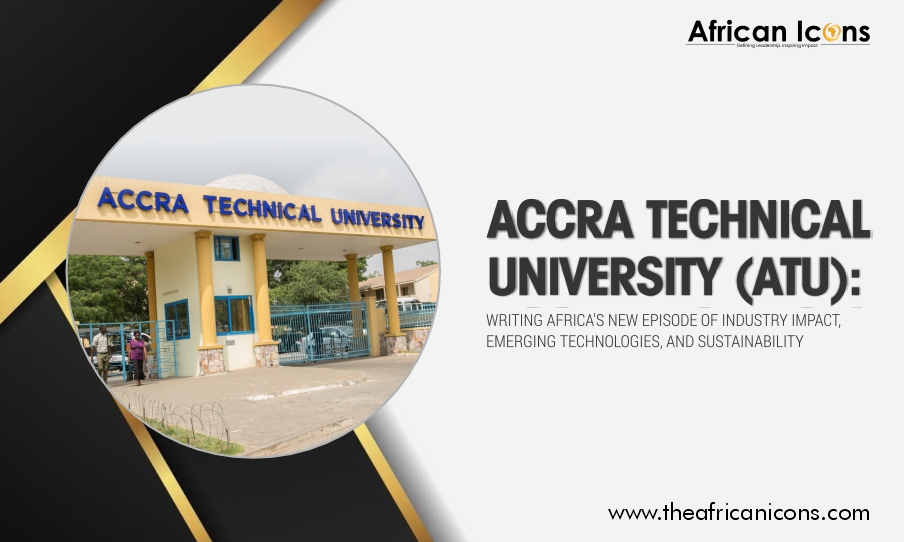
The sustainable future of humanity rests on the shoulders of the leaders of tomorrow, that is, today’s graduates. They understand that technological advancements must always be grounded in the ultimate aim of holistic human empowerment. In that regard, Accra Technical University (ATU) has entered a transformative phase guided by its Strategic Plan (2026–2030), which sets a clear direction for institutional growth and societal impact. The present Vice-Chancellor, Engr. Dr. Prof. Amevi Acakpovi, FPE-IET, Snr M.IEEE, states, “Our renewed vision is ‘to be the preferred Technical University in Africa, for industry impact, emerging technologies, and sustainability.”
He continues that this vision reflects their commitment to producing graduates who are not only technically competent but also capable of contributing to industrial transformation and economic development.
ATU’s mission is to advance technical knowledge by creating a conducive environment for applied research, quality teaching, and competency-based training with high impact on industry and business creation.
Holistic Learning for Human Upliftment
Guided by its educational philosophy—‘Education and Training for Employment and Job Creation’—ATU focuses on equipping students with practical competencies, innovative thinking, and entrepreneurial skills that prepare them to thrive in a technology-driven global economy.
The University continues to strengthen student success through expanded academic programmes, improved infrastructure, and enhanced industry engagement. Today, ATU offers 35 four-year Bachelor of Technology programmes and 17 postgraduate programmes, creating a complete pathway from technical training to advanced research and professional practice.
Technical universities must remain closely connected to industry, believes Prof. Amevi. At ATU, he adds that they achieve this through competency-based training, industry collaboration, and continuous curriculum review.
Their programmes are developed and reviewed in collaboration with industry stakeholders through Programme Advisory Committees, ensuring that academic content reflects real-world technological developments and labour market needs.
They also integrate Work-Based Learning (WBL), internships, and industry placements into many of our programmes. This approach allows students to apply theoretical knowledge in real work environments while building professional networks.
Furthermore, ATU continuously monitors global and national trends in areas such as digitalization, artificial intelligence, renewable energy, and sustainable technologies, integrating these developments into teaching and research activities.
“Through these mechanisms, we ensure that our graduates possess the skills and competencies required for modern industry and future workplaces,” adds Prof. Amevi.
The Key Pillars of Modern Education
Innovation, practical learning, and international collaboration are among the defining pillars of modern higher education. At Accra Technical University (ATU), these principles are deeply embedded in the University’s teaching philosophy and institutional strategy. As a leading technical university, ATU places strong emphasis on experiential learning through competency-based education, project-based assignments, industrial attachments, simulation laboratories, and research-driven innovation. Students are continually challenged to solve real-world engineering and technological problems, thereby developing the practical competencies, creativity, teamwork, and critical thinking skills demanded by today’s rapidly evolving workplace.
To reinforce this approach, the University has invested significantly in innovation and applied research. Through platforms such as the Accra Technical University Research and Innovation Forum (ARIF), faculty research groups, innovation exhibitions, technology demonstrations and entrepreneurship initiatives, students and staff are encouraged to transform ideas into practical products and services that address societal and industrial needs. These initiatives nurture a culture of innovation while preparing graduates to become job creators as well as job seekers.
Strategic Industry and Global Partnerships
Recognising that technical universities thrive through close interaction with industry and the global academic community, ATU has adopted an ambitious partnership strategy that connects education, research, innovation and enterprise. The University actively collaborates with industries, government agencies, development partners and higher education institutions to strengthen curriculum delivery, facilitate internships, promote applied research, support technology transfer and enhance graduate employability.
At the international level, ATU has established enduring collaborations with renowned institutions such as Nanjing University of Information Science and Technology (NUIST), China, where joint research, postgraduate supervision, staff exchanges and collaborative programmes continue to flourish in areas including artificial intelligence, climate science and environmental technologies. The University also maintains productive partnerships with organisations such as Africa Works Alliance (AWA), which support technical training, renewable energy development and industrial capacity building.
Building on these foundations, ATU has significantly expanded its international network through a series of strategic engagements across Africa. In Rwanda, the University signed Memoranda of Understanding with Kigali Independent University (ULK), ULK Polytechnic Institute (UPI) and the University of Rwanda (UR) to promote academic exchanges, collaborative research, postgraduate education, innovation and entrepreneurship. Similar partnerships were concluded in Uganda with Makerere University, Kyambogo University and Kampala International University (KIU), creating new opportunities for joint teaching, staff and student mobility, research collaboration and institutional capacity development.
The University’s internationalisation agenda further extended to Côte d’Ivoire, where landmark agreements were signed with the Ministère de l’Enseignement Technique, de la Formation Professionnelle et de l’Apprentissage (METFPA) and the prestigious Institut National Polytechnique Félix Houphouët-Boigny (INP-HB). These collaborations are opening new avenues for bilingual education, technical and vocational skills development, dual-degree programmes, policy exchange and collaborative innovation between Anglophone and Francophone Africa.
ATU’s growing international reputation has also been demonstrated through its active participation in high-level global academic engagements. During recent visits to the United Kingdom, the Vice-Chancellor represented the University at prestigious conferences hosted by the University of Cambridge and Lancaster University, where he contributed to discussions on the future of higher education, entrepreneurial universities, institutional governance, sustainability and innovation. These engagements have further enhanced ATU’s international visibility while creating opportunities for new collaborations with universities, research institutions and industry partners in Europe.
Alongside its international partnerships, ATU continues to maintain strong relationships with Ghanaian industries. Collaborations with organisations such as Npontu Technologies, Kantanka Automobile Company, and other industry partners provide students with invaluable opportunities for industrial attachments, collaborative research, technology demonstrations, mentorship and guest lectures delivered by experienced professionals. These partnerships ensure that academic programmes remain aligned with current industry practices while exposing students to modern technologies and real-world engineering challenges.
Today, ATU’s partnership ecosystem spans Africa, Europe, Asia and North America, creating a vibrant environment where academia, industry, government and international partners work together to advance teaching, research and innovation. Through these strategic collaborations, the University continues to broaden the horizons of its students and staff, enhance graduate employability, strengthen research capacity and accelerate its vision of becoming Africa’s most preferred Technical University for sustainability-driven, industry-led and innovation-based education.
Achieving a Global Distinction
In a competitive global education landscape, Accra Technical University stands out because of its unique blend of technical education, innovation, and strong industry engagement.
First, ATU’s programmes emphasize competency-based and practice-oriented learning, ensuring that graduates possess practical skills that are immediately applicable in industry. Teaching is complemented by modern laboratories, workshops, and hands-on project-based learning that replicate real industrial environments. Continuous investments in equipment and practical training facilities further strengthen the University’s capacity to deliver industry-relevant technical education.
Second, ATU aligns its institutional development with major national and global development frameworks, including the United Nations Sustainable Development Goals (SDGs) and the African Union Agenda 2063, ensuring that our teaching, research, and innovation contribute meaningfully to sustainable development, industrial growth, and technological transformation across Africa.
Third, the University has built a strong ecosystem for applied research, innovation, and entrepreneurship. A key illustration is the recent establishment of the Centre for Entrepreneurship and Incubation Services (CEIS) at ATU. The Centre supports student innovators and young entrepreneurs through mentorship, startup incubation, innovation training, and industry linkages, enabling them to transform creative ideas into viable businesses and technological solutions.
Public and Private Collaborations
ATU has also strengthened its collaboration with leading training institutions and industry-focused organizations such as the Design and Technology Institute (DTI), a private technical university in Ghana supported by the Mastercard Foundation. Through this partnership, ATU benefited from the renovation of a modern welding training centre on campus and the retooling of several laboratories and workshops under the Precision Quality training concept.
The Precision Quality approach emphasizes high standards of technical workmanship, modern production processes, and internationally competitive industrial skills. This collaboration has significantly enhanced ATU’s practical training environment and strengthened the quality of hands-on engineering and technical education offered to students.
Together, these initiatives illustrate ATU’s commitment to bridging the gap between academic learning and industrial practice, creating an ecosystem where students develop the technical competence, innovative mindset, and entrepreneurial capabilities required to thrive in a rapidly evolving global economy.
These strengths position Accra Technical University as a key driver of innovation, skills development, and technological advancement in Ghana and across the African region.
Going Beyond Academics
Student development goes beyond academics. At Accra Technical University, Prof. Amevi says, “We believe that higher education must nurture leaders, innovators, and entrepreneurs, equipping students not only with technical knowledge but also with the confidence, creativity, and leadership skills required to succeed in a dynamic global economy.”
To achieve this, the University has established a dedicated Career and Skills Development Centre, which plays a pivotal role in preparing students for the world of work. The Centre organizes an annual Career Fair, bringing together leading companies, industry professionals, and recruiters to interact directly with students. This platform allows students to explore career opportunities, receive mentorship from industry experts, and gain valuable insights into emerging industry trends.
ATU also operates a Virtual Internship Programme (VIP), which enables students to undertake structured internship experiences remotely with partner institutions and companies. This innovative approach expands access to industry exposure, particularly in sectors where physical placements may be limited, while allowing students to build professional competencies in real-world project environments.
Student development is further strengthened through a variety of co-curricular and innovation-driven activities. The University regularly organizes skills competitions, hackathons, technology innovation challenges, and student debates, providing platforms for students to demonstrate their talents, develop problem-solving abilities, and compete at both national and international levels. Outstanding performances in these competitions are recognized and rewarded, reinforcing a culture of excellence and healthy academic competition.
Entrepreneurship education is also integrated across several programmes, encouraging students to develop business ideas and transform innovations into viable enterprises. Through mentorship programmes, alum networks, and industry engagement platforms, students receive guidance, professional exposure, and practical experience that prepare them for leadership roles in their respective fields.
Collectively, these initiatives create a vibrant learning environment that empowers students to become job creators, innovators, and agents of societal transformation rather than merely job seekers.
Redefining Education Worldwide
Digital transformation is a central pillar of ATU’s Strategic Plan. The University is expanding its ICT infrastructure, digital learning platforms, and online academic systems to enhance teaching, research, and institutional management.
We are also integrating emerging technologies such as Artificial Intelligence, Internet of Things (IoT), Virtual Reality, and Augmented Reality into academic programmes to prepare students for the digital economy.
Additionally, ATU is strengthening its digital libraries, e-learning systems, and innovation hubs to support research and knowledge sharing. These initiatives are helping to create a technology-driven learning environment aligned with global educational trends.
Internationalization is a key pillar of Accra Technical University’s development strategy, reflecting the institution’s commitment to strengthening its global academic footprint and fostering knowledge exchange across borders.
The University continues to expand partnerships with institutions across Africa, Europe, and Asia, focusing on joint research, academic exchange, technology transfer, and collaborative innovation projects. These partnerships facilitate student and faculty mobility, joint academic programmes, research collaboration, and capacity-building initiatives, all of which contribute to strengthening ATU’s global academic profile.
Over the past year, ATU significantly deepened its engagement across West Africa, establishing and strengthening collaborations with several renowned universities and research institutions in countries such as Benin, Togo, Nigeria, Burkina Faso, Gabon, and The Gambia. These partnerships have supported academic exchanges, joint conferences, collaborative research initiatives, and regional knowledge sharing within the West African higher education ecosystem.
A Powerful Vision for Tomorrow
Looking ahead, ATU is expanding its international engagement further by targeting strategic collaborations at the continental level with universities in Eastern Africa, particularly in countries such as Rwanda and Uganda, which are emerging hubs for technological innovation and higher education development. In addition, the University is strengthening its outreach toward Japan, where partnerships with advanced technological institutions are expected to support research collaboration, innovation, and capacity development in emerging technologies.
Through these collaborations, ATU is positioning itself as a globally connected technical university, actively contributing to international technological advancement while fostering cross-cultural academic exchange and innovation-driven development.
Furthermore, Entrepreneurship is embedded in ATU’s academic philosophy.
Students are encouraged to develop innovative ideas that address societal and industrial challenges. Through innovation hubs, incubation programmes, and project-based learning, students gain experience in transforming ideas into practical solutions.
The University also promotes applied research and innovation that supports startup development and technology commercialization.
This entrepreneurial ecosystem empowers students to create businesses, generate employment, and contribute to national economic growth.
Also, ATU supports graduate employability through a range of initiatives.
The University operates a Career and Skills Development Centre, which provides career guidance, professional development training, and employment support.
Students also benefit from internship programmes, industry networking events, and mentorship opportunities.
These initiatives ensure that graduates transition successfully from university education into professional employment or entrepreneurial ventures.
The Strategic Plan Powered by Seven Pillars
Sharing their future priorities, Prof. Amevi divulges the 2026–2030 Strategic Plan, outlining seven major pillars that will guide ATU’s development:
- Competency-Based Training and Future-Ready Teaching and Learning
- Digital Transformation and Modernised Infrastructure
- Quality Assurance and Institutional Excellence
- Industry-Driven Applied Research, Innovation, and Entrepreneurship
- Staff Development, Motivation, and Welfare
- Strategic Partnerships and Increased Visibility
- Green Technologies and Sustainability
These pillars will guide the University in strengthening academic excellence, expanding research capacity, and increasing its international recognition.
Thus, Prof. Amevi insists that Accra Technical University offers students a unique opportunity to develop practical skills, innovative thinking, and entrepreneurial capacity in a supportive academic environment.
He adds, ‘Our commitment is to provide education that transforms lives and contributes to the technological and industrial advancement of society.”
“We invite aspiring students and future leaders to join ATU and become part of a community dedicated to innovation, excellence, and sustainable development,” he concludes.