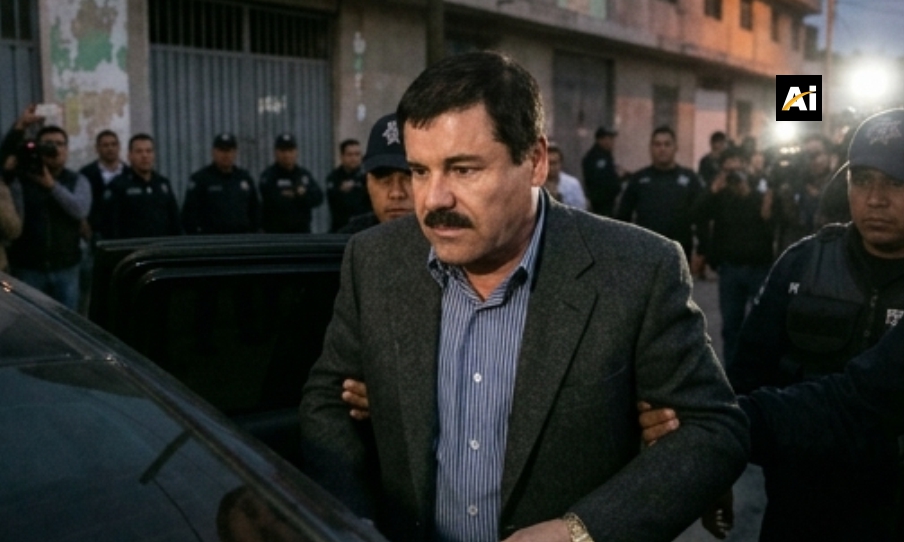
Money tied to Joaquín “El Chapo” Guzmán mixes legend, careful number tracing, yet also the massive size of drug markets worldwide. For years, the head of the Sinaloa group seemed beyond reach – his riches said to match major international businesses. Still, pinning down his exact fortune isn’t like looking up shares on a screen. It means chasing invisible cash: huge sums flowing beneath borders, inside fake firms, aboard luxury planes – soaked into shadows. In the end, nobody really knows how much of it stuck in his own hands.
The Forbes Era and the Billion Dollar Myth
That year, a wanted man showed up among the globe’s richest people. A well-known criminal named El Chapo was listed with about a billion dollars. His name sat next to famous business leaders from Silicon Valley and energy tycoons. Officials in Mexico were furious over the announcement. Yet the placement highlighted how much influence he actually held. The number came mostly from tons of drugs shipped across the border. Cocaine and heroin flowed steadily through networks run by the Sinaloa group. Experts looked at street prices and distribution scales. Even small shares of those earnings pushed his wealth into rare territory. Suddenly, an outlaw ranked near the top of economic standings.
Still, handling that kind of money turned out to be messy. Not like running a regular company – running a cartel meant huge ongoing expenses, like paying off government workers every month with millions, keeping armed men ready at all times, losing shipments again and again when authorities stepped in. Come 2013, the magazine dropped his name, saying they could not confirm how much cash he actually held. His supposed fortune sparked questions: really a billionaire, or just someone moving large amounts who never kept it long enough to count – gone faster than ash rising from scorched opium crops?
The U.S. Government’s $12.6 Billion Forfeiture
Following his final capture and subsequent extradition to the United States, the legal system attempted to put a definitive price tag on his criminal career. During his high-profile trial in Brooklyn, prosecutors sought a forfeiture order totaling $12.6 billion. This staggering sum was not based on cash found in a vault, but rather on a historical calculation of the total drug sales attributed to his leadership over nearly three decades. This federal estimation of the El Chapo Net Worth represented the gross receipts of a global empire, covering thousands of kilograms of narcotics distributed across North America.
Despite this monumental court order, a significant problem emerged: the money was nowhere to be found. Investigators admitted that they had not seized even a fraction of that $12.6 billion. While testimony revealed a lifestyle of gold-plated pistols, private zoos, and beachfront villas, the liquid El Chapo Net Worth remained elusive. The defense argued that the government’s figures were “fictional,” pointing out that the Sinaloa Cartel operated more like a federation than a monolith, with profits split among various capos and local commanders.
The Hidden Assets and Modern Forensic Challenges
The difficulty in pinning down the El Chapo Net Worth today lies in the sophisticated nature of modern money laundering. During his peak years, Guzmán reportedly utilized a network of hundreds of shell companies, stretching from real estate in Mexico to businesses in South America and beyond. Even with the kingpin behind bars in a supermax prison, the assets tied to the El Chapo Net Worth likely remain dispersed among his family members and associates. The “Los Chapitos” faction, led by his sons, continues to operate, suggesting that the infrastructure of wealth he built is still generating revenue, even if it is technically “off the books.”
Efforts to recover these funds have sparked diplomatic tensions. The Mexican government has expressed interest in reclaiming any seized assets, arguing that the money should be returned to the communities affected by cartel violence. Yet, without a digital paper trail or a centralized bank account, the El Chapo Net Worth remains more of a theoretical concept than a recoverable treasury. It serves as a stark reminder of how difficult it is for modern law enforcement to dismantle a financial empire built on cash, secrecy, and the exploitation of global black markets.
The Lasting Impact of Narcotic Economics
As we look at the historical data, the El Chapo Net Worth stands as a testament to the astronomical profits available in the illicit drug trade. Even if the $12.6 billion figure was a gross exaggeration of his personal bank account, the influence that money bought was undeniably real. It funded escapes from maximum-security prisons, corrupted high-ranking politicians, and fueled a bloody conflict that changed the landscape of Mexico. The El Chapo Net Worth was never just about luxury; it was about the power to operate outside the law.
Ultimately, the search for his missing billions continues to fascinate the public. Whether the el chapo net worth was $1 billion or $12 billion, the true cost of his empire is measured in the lives lost to addiction and violence. While the man himself may never see a cent of that money again, the shadow cast by his wealth continues to loom over the international effort to curb organized crime. The hunt for the “missing billions” remains a high-stakes game of financial hide-and-seek that may never reach a definitive end.
Beyond the Balance Sheet
In the end, the story of the el chapo net worth is a cautionary tale about the limits of forensic science when faced with a shadow economy. We may never know the exact number of zeros in his secret accounts, but the legacy of the Sinaloa Cartel’s finances will be studied by economists and criminologists for decades. The El Chapo Net Worth is a figure that exists in the gray area between fact and folklore, a symbol of a time when a “farmer” from Sinaloa could challenge the financial might of nations. Even with the leader silenced, the ghosts of those billions continue to haunt the global financial system.