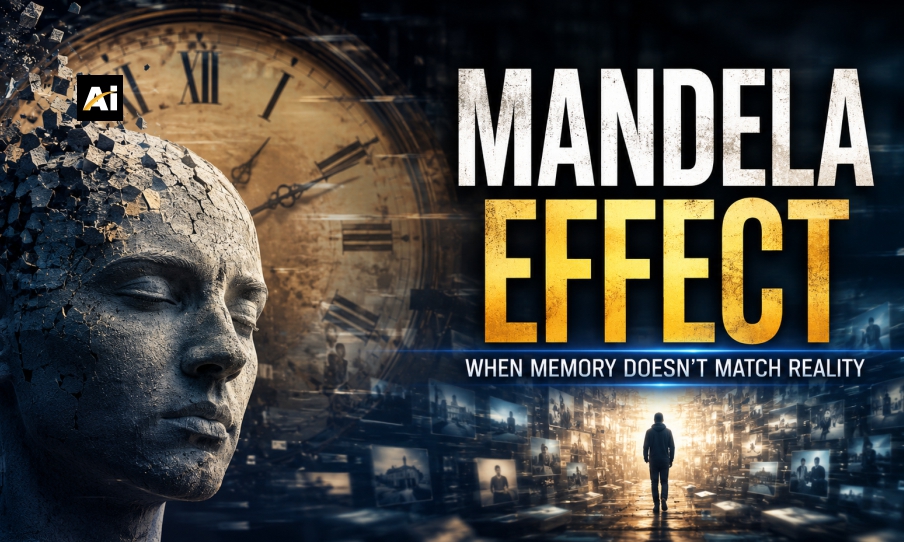
Have you ever known for a fact that something could not have happened the way you remember it? Perhaps you had incorrectly recalled a quote from a movie or a quote from a book. Such situations may be disheartening since you cannot rely on your own memory. A similar situation, which has become widely known as the Mandela Effect, has occurred with many people nowadays.
Therefore, if you are asking yourself, “what is the Mandela Effect,” you are not alone – thousands of people have asked the same question. Mandela Effect meaning has been a subject of many theories, most of which state that the phenomenon is related to multiple universes. However, scientists have not yet managed to prove such assumptions, and the most plausible Mandela Effect definition states that it is just a flaw in human memory.
The Origins of the Mandela Effect
The easiest way to explain the Mandela Effect is to provide the story behind its origin. The phenomenon got its name from the famous conspiracy theorist Fiona Broome, who recalled that she once had a vivid dream about Nelson Mandela passing away in prison. However, when she checked the news, she learned that Mandela did not die in custody. In fact, he was released in 1990 and became the President of South Africa in 1994, and he passed away in 2013.
Later, Fiona realized that she was not the only one who had such a false memory – thousands of people around the globe believed that Mandela had died in prison. Hence, now anyone who asks, “what is the Mandela Effect,” will be told that it is a phenomenon related to collective false memories.
The internet amplified interest in these cases, with communities collecting examples from movies, books, advertisements, and historical events. Some examples are minor spelling differences, while others involve memorable scenes or quotations that many people confidently—but incorrectly—recall.
Why Our Brains Create False Memories
Psychologists explain that memory isn’t like a video recording stored in the brain. Instead, every memory is reconstructed whenever we recall it. During this process, the brain fills in missing details using logic, experience, and surrounding information. This makes memories surprisingly flexible and, at times, inaccurate.
When discussing what is the Mandela Effect, cognitive psychology points to several mechanisms that contribute to collective false memories. One major factor is misinformation. If enough people repeat an incorrect version of an event, others may gradually adopt that version as their own memory. Social influence also plays a role, especially in the age of social media where misinformation spreads rapidly.
Another reason involves pattern recognition. Our brains naturally seek familiar structures, making us more likely to “correct” unfamiliar spellings or remember phrases in a way that sounds more natural. Over time, these reconstructed memories feel just as real as genuine ones.
This doesn’t mean people are lying. In most cases, they sincerely believe their recollections are accurate because confidence in a memory isn’t always linked to its correctness.
Popular Examples That Continue to Surprise People
One reason people remain fascinated by what is the Mandela Effect is the sheer number of examples that circulate online. Many people remember the children’s book series as “The Berenstein Bears,” even though the books have always been titled “The Berenstain Bears.” Others confidently recall the Monopoly mascot wearing a monocle, despite the character never having one.
Movie quotes are another common source of confusion. The famous line from Star Wars is widely remembered as “Luke, I am your father,” although the actual dialogue is “No, I am your father.” Similarly, many people recall the mirror quote from Snow White as “Mirror, mirror on the wall,” while the original film begins with “Magic mirror on the wall.”
Brand logos also contribute to the phenomenon. Small design changes or assumptions based on visual familiarity can create lasting false memories shared by millions. Because these examples involve things people have seen repeatedly throughout their lives, discovering the truth often comes as a genuine surprise.
Although these cases appear mysterious, researchers argue they demonstrate just how easily memory can be influenced by repetition, expectation, and cultural exposure.
Science, Speculation, and Why the Mystery Persists
Whenever conversations turn to what is the Mandela Effect, two very different viewpoints usually emerge. The scientific community largely attributes it to memory errors, cognitive biases, and the reconstructive nature of human recall. Numerous psychological studies support the idea that false memories are common and can even be created under controlled experimental conditions.
On the other hand, some enthusiasts propose more extraordinary explanations. Popular theories include alternate timelines, parallel universes, glitches in reality, or changes in the fabric of existence itself. While these ideas make for entertaining discussions and fictional storytelling, there is currently no scientific evidence supporting them.
The enduring popularity of the phenomenon lies in its emotional impact. Discovering that your strongest memories may be inaccurate forces you to question how reliable your mind truly is. It reminds us that confidence doesn’t always equal accuracy and that human memory is far more complex than most people realize.
Ultimately, learning what is the Mandela Effect offers more than just intriguing trivia. It provides insight into the remarkable strengths and surprising limitations of the human brain. Rather than proving alternate realities, the phenomenon highlights how our minds continuously interpret, reconstruct, and sometimes reshape the past. That realization is both fascinating and humbling, encouraging us to approach even our most certain memories with a little curiosity and an open mind.