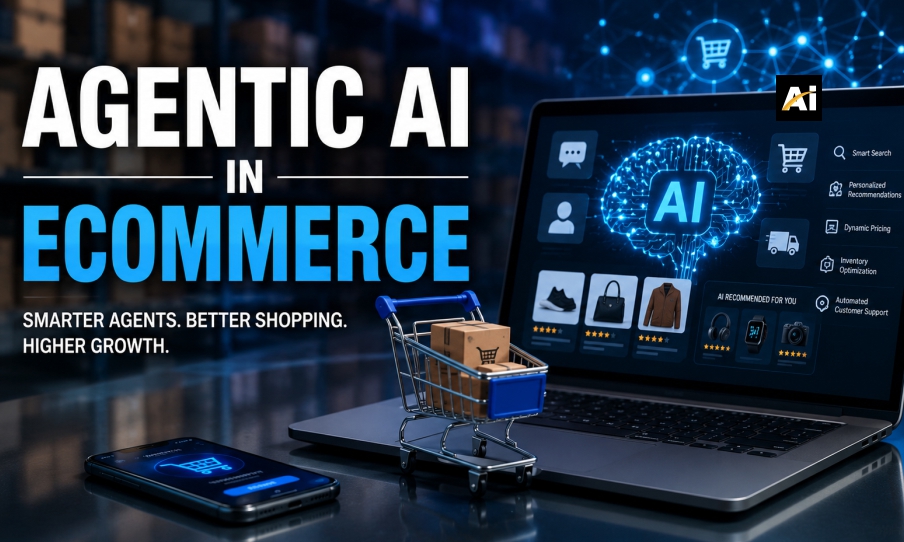
The ecommerce industry has always been at the forefront of adopting emerging technologies. It has eagerly embraced solutions ranging from recommendation engines to chatbots in order to better engage customers and optimize operations. But now, the ecommerce space is witnessing the arrival of a new innovation, namely, agentic AI.
In contrast to conventional artificial intelligence, agentic AI is capable of perceiving its environment and performing certain actions in order to achieve particular goals. By implementing such groundbreaking technology, online retailers will be able to operate more efficiently and provide customers with better shopping experiences.
Therefore, in the modern marketplace where competition is fierce, the ability to utilize agentic AI may give companies a decisive edge.
Understanding the Concept of Agentic AI in Ecommerce
At present, many companies use traditional AI to perform various routine tasks. Such programs are typically designed to take specific actions depending on the input information. For instance, recommendation algorithms are able to suggest products that a user may be interested in purchasing. Additionally, some AI software can answer frequently asked questions via natural language processing. However, the main limitation of such programs is that they cannot operate on their own and require constant human supervision.
Meanwhile, agentic AI in ecommerce refers to a program that is capable of accomplishing multiple tasks in order to achieve certain objectives. Unlike conventional artificial intelligence, which typically performs one particular action when exposed to a certain trigger, agentic AI is generally more autonomous and efficient. For example, while traditional AI is only capable of responding to customer requests, agentic AI is able to serve a request, process the input data, and update the information base in order to enhance the user experience.
For instance, if inventory levels begin dropping rapidly during a seasonal sale, an agentic AI system could detect the trend, forecast future demand, recommend replenishment quantities, communicate with suppliers, and notify relevant managers without requiring manual intervention at every stage.
This ability to reason through complex scenarios enables businesses to operate with greater speed and efficiency.
Enhancing Customer Experiences Through Intelligent Automation
Customer expectations continue to rise. Shoppers now expect personalized recommendations, instant support, accurate delivery estimates, and seamless purchasing journeys across multiple devices. Meeting these expectations consistently can be difficult without advanced automation.
One of the greatest strengths of agentic ai in ecommerce is its ability to understand customer behavior beyond simple browsing history. It evaluates purchase intent, seasonal trends, browsing patterns, product comparisons, abandoned carts, and even contextual signals to deliver highly relevant experiences.
Instead of simply recommending products, an intelligent AI agent may proactively suggest complementary items, offer personalized discounts based on customer loyalty, answer detailed product questions, arrange delivery preferences, and guide buyers throughout the purchase journey.
Customer service also benefits significantly. Rather than transferring shoppers between multiple support agents, AI can independently resolve refund requests, initiate replacement orders, track shipments, and escalate only the most complex issues to human representatives.
This creates faster response times while allowing customer support teams to focus on high-value interactions that require empathy and nuanced decision-making.
Transforming Business Operations Behind the Scenes
While customers experience the visible benefits, businesses gain equally valuable operational improvements. Modern ecommerce companies manage thousands of products, multiple warehouses, diverse suppliers, dynamic pricing, and constantly changing customer demands.
This complexity makes autonomous decision-making incredibly valuable.
Using agentic ai in ecommerce, businesses can continuously monitor inventory, analyze supplier performance, forecast demand fluctuations, optimize warehouse operations, and recommend pricing adjustments based on competitor activity and market conditions.
Marketing teams also benefit from intelligent automation. Rather than manually creating audience segments or adjusting campaigns, AI agents can monitor campaign performance in real time, allocate advertising budgets, generate personalized email sequences, recommend promotional strategies, and optimize conversion rates across multiple channels.
Fraud detection becomes more sophisticated as well. Instead of relying solely on fixed rules, AI agents analyze behavioral patterns, transaction histories, device information, and purchasing anomalies to identify suspicious activities before financial losses occur.
Supply chain management is another area where autonomous intelligence creates measurable value. AI agents can anticipate shipping delays, identify alternative suppliers, optimize logistics routes, and reduce operational disruptions before they impact customers.
These capabilities allow organizations to become more agile while reducing operational costs and improving overall efficiency.
Challenges Businesses Must Consider Before Adoption
Although the benefits are substantial, implementing advanced AI systems requires careful planning.
High-quality data remains the foundation of successful AI deployment. Poor data quality can lead to inaccurate decisions, ineffective recommendations, and operational inefficiencies. Businesses must invest in reliable data collection, governance, and ongoing monitoring.
Privacy and security are equally important. As AI systems gain greater autonomy, organizations must ensure customer information remains protected while complying with evolving data privacy regulations.
Human oversight also continues to play a critical role. While autonomous systems can perform many tasks independently, strategic decisions involving ethics, legal compliance, brand reputation, and customer relationships still require experienced human judgment.
Another challenge involves integrating AI with existing ecommerce platforms, customer relationship management systems, inventory software, and payment infrastructure. Successful implementation often requires collaboration between technology teams, business leaders, and operational departments.
Finally, organizations should focus on gradual adoption rather than attempting complete automation immediately. Starting with targeted business functions allows companies to evaluate performance, refine workflows, and build confidence before expanding AI capabilities across the organization.
The Future of Intelligent Ecommerce
The future of ecommerce is moving toward systems that do far more than analyze information. They will increasingly plan, collaborate, execute, and continuously improve their own performance within clearly defined business objectives.
As AI technologies mature, online stores may eventually operate with digital teams of autonomous agents responsible for inventory management, customer engagement, pricing optimization, marketing campaigns, fraud prevention, and supply chain coordination—all working together while remaining under human supervision.
Businesses that begin experimenting today will be better prepared for this transformation. Rather than replacing employees, intelligent agents will augment human capabilities by handling repetitive, data-intensive processes while allowing people to focus on creativity, strategy, relationship building, and innovation.
The evolution of agentic ai in ecommerce represents a significant milestone in digital commerce. Companies that embrace this shift thoughtfully can deliver superior customer experiences, improve operational efficiency, and remain competitive in an increasingly intelligent online marketplace.