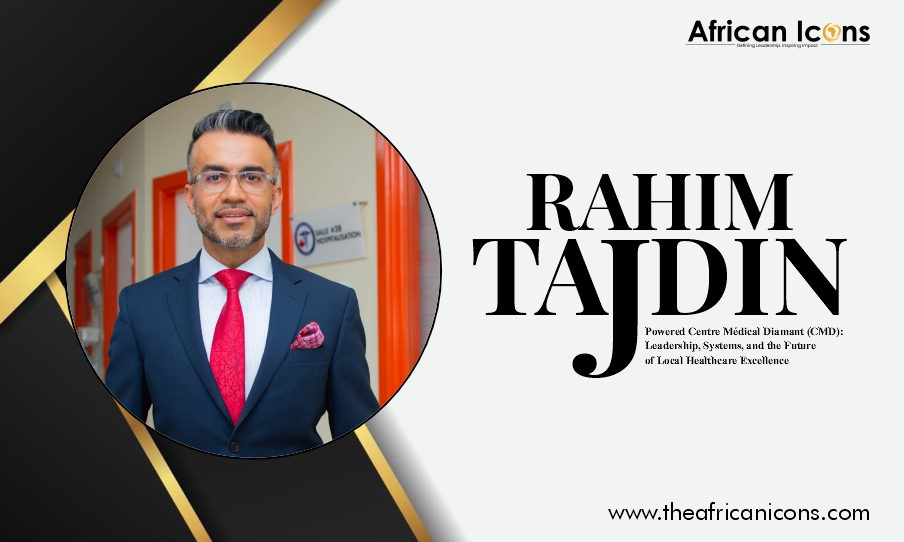
There is one of the most empowering leaders, Rahim Tajdin, who, with his pioneering endeavour, Centre Médical Diamant (CMD), has been establishing autonomous healthcare infrastructure in the heart of Africa. “Healthcare excellence should not be imported forever. It should increasingly be built locally, made in DRC,” says Rahim Tajdin, whose passion is Business Innovation in Africa and Board Governance. As a corporate leader, he addresses the structural dependencies that often limit local medical networks, shifting the regional focus from external reliance to local operational self-sufficiency. Holding a Master’s Degree in Innovation Management, Rahim Tajdin applies advanced development principles to alter the delivery of health services within the Democratic Republic of Congo. He studies how corporate structures adapt to difficult operating environments, using his varied career insights across the telecommunications, construction, automotive parts, and non-profit industries to fortify regional healthcare mechanics.
Through his leadership at CMD, Rahim Tajdin introduces robust management frameworks that establish high-capacity clinical hubs across Kinshasa. He configures this private network to operate under strict Canadian standards, filling a critical national gap for immediate, dependable emergency care. Under his administration, CMD campuses expand their diagnostic capabilities, providing round-the-clock laboratory analysis and advanced medical imagery alongside dedicated surgery, dentistry, and ophthalmology wings. By training internal teams to run automated diagnostic loops smoothly, he removes the administrative and logistical delays that traditionally force patients to seek specialized healthcare services abroad.
Rahim Tajdin, believing enthusiastically in cross-industry innovation and strategic governance for public health, shapes the regional corporate landscape across the present, using his position on executive boards to build scalable business architectures that protect human life. He notes that multi-sector experience helps enterprise directors view public health as a complex operational system that requires high-velocity logistics and strict asset tracking. At CMD, his development divisions build modern maternity and neonatology units, ensuring that complex infant care remains available locally to all families. His technical background in systems optimization allows the hospital group to maintain a steady flow of pharmaceutical inventory and emergency consumables, even during severe international supply chain disruptions.
Rahim Tajdin positions CMD as an accessible provider of premium medical care. That way, he shifts corporate social responsibility & hospital administration’s trajectory in Central Africa. Demonstrating that business strategies become resilient when they adapt directly to the needs of the population, this strategy of his balances immediate clinical rescue operations with long-term infrastructure upgrades. The regional consumer markets grow, and urban densities rise. Amidst this changing situation, Rahim Tajdin and CMD continue to scale their surgical capacities, establishing a predictable, local standard of clinical care that allows domestic industries to thrive safely.
He spoke, in an exclusive interview with The African Icons’ team, offering deep and rich insights into his mind, his methods, and his past-present and the most probable future journey. Let us get enriched with novel perspectives.
The Vision of Accessible Excellence: Centre Médical Diamant (CMD) has become a benchmark for healthcare in the Democratic Republic of the Congo. What was the primary gap in the regional medical landscape that inspired you to establish a center combining international standards with local accessibility?
Having grown up in Canada and later choosing to build in the DRC, I had the opportunity to experience two very different realities.
What struck me was not simply the difference in infrastructure. It was the difference in expectations. Too many families had quietly accepted the idea that if a medical situation became sufficiently complex, the answer was no longer to look locally but to leave the country.
A difficult pregnancy? Travel.
Cancer? Travel.
Cardiac disease? Travel.
Over time, that mindset becomes concerning because people stop asking whether local excellence is possible. I remember thinking that this was the wrong starting point. Why should quality healthcare automatically exist somewhere else? Why should proximity to advanced care depend on geography?
That question became one of the foundations of Centre Médical Diamant.
From the beginning, our ambition was not simply to build a hospital with modern equipment or attractive facilities. We wanted to contribute to rebuilding confidence in local healthcare and proving that world‑class standards, discipline, innovation, and compassion can be developed here.
Today, some of the moments that stay with me most are not milestones related to equipment integration or expansion announcements. They are moments when families realize they did not have to leave home.
That shift in belief is powerful.
“Healthcare excellence should not be imported forever. It should increasingly be built locally, made in DRC.” (note for design- use this as a quote separately).
Leadership in High-Stakes Environments: Managing a healthcare network requires a unique balance of empathy and operational precision. How would you define your ‘empowering’ leadership style?
Healthcare is unlike most sectors because every operational decision eventually becomes personal to someone. Behind every delay, every improvement, every investment, there is a patient, a family, and often a very emotional moment. That reality shapes how I lead.
I do not see leadership as being the smartest person in the room or making every important decision myself. My role is to create conditions where talented people can consistently make excellent decisions. My leadership personality, based on many personality tests I’ve taken, is that of a coach. I love to coach my team so that they reach new personal heights!
That means building clarity, setting ambitious expectations, creating accountability, and giving people the confidence to act. I also strongly believe that institutions become fragile when knowledge and authority concentrate in too few people. One of the questions I ask myself often is: if one person disappears tomorrow, will quality remain? If the answer is no, then we have work to do.
At CMD we have tried to build leadership through training, open communication, protocols, feedback loops, and a culture where improvement is everyone’s responsibility and everyone feels psychologically safe to raise flags, identify areas of opportunity. Excellence should not depend on pressure. It should become habit. A culture!
“Excellence should not depend on pressure. It should become habit. A culture!” (note for design- use this as a quote separately).
Scaling Healthcare Infrastructure: What have been the most significant challenges in building a healthcare model that is ‘system-dependent’ rather than ‘person-dependent’?
Here, I’d like to discuss human capital and culture.
One of the hardest lessons in growth is that success exposes weaknesses. When institutions are small, exceptional people compensate for imperfect systems. As organizations grow, that stops working. Very early, we became intentional about building systems rather than depending on individuals.
That included digital infrastructure, governance mechanisms, quality processes, standardization, and clearer operational discipline. I would argue that CMD was fully ISO 9001 compliant at least 7 years before it acquired the certification!
Healthcare in the DRC introduces additional layers of complexity. You are simultaneously thinking about energy reliability, specialized recruitment, equipment maintenance, supply chains, training, digital connectivity, and patient experience. Those challenges are real.
That being said, I think the hardest challenge is cultural. Institution-building requires discipline, consistency, documentation, and accepting that sustainable excellence often feels less heroic than improvisation. Our ambition is that patients should experience the same quality of care regardless of who is on duty or which site they visit.
“Our ambition is that patients should experience the same quality of care regardless of who is on duty or which site they visit.” (note for design- use this as a quote separately).
The Integration of Modern Medical Technology: How are you leveraging modern medical technologies while maintaining digital trust regarding sensitive patient data?
At CMD, we have never viewed technology as the objective. Technology only matters if patients experience better outcomes because of it.
For us, digital transformation started with a simple question: how do we help clinicians make better decisions while giving patients a smoother, more holistic experience of care?
Digital medical records became important because continuity matters. Patients should not have to repeat their medical history every time they meet a different provider. Technology improves coordination, reduces delays, and allows the right information to reach the right people at the right time.
But healthcare creates another responsibility that is often underestimated: peace of mind.
We increasingly see technology not only as a clinical tool, but also as a way to reduce uncertainty and anxiety for patients and families.
Patients should not be wondering whether their samples were received and analyzed, whether the next step has been scheduled, or whether information was lost between departments.
Our goal has been to create an integrated and automated experience where patients feel informed, supported, and reassured throughout their care journey. That confidence changes the experience of healthcare.
When patients feel that care is coordinated, predictable, and transparent, they experience less stress, greater trust, and more confidence in focusing their energy where it belongs: on healing.
This is why, for us, the future of healthcare is not simply more technology. It is technology that quietly creates better medicine—and greater peace of mind.
“The future of healthcare is not simply more technology. It is technology that quietly creates better medicine—and greater peace of mind.” (note for design- use this as a quote separately).
Bridging the Global-Local Paradox: How do you adapt international best practices to the socioeconomic realities of the DRC?
One principle we have tried to maintain is that international does not automatically mean better.
At the same time, local constraints should never become an excuse for lower standards. Our approach is to learn globally and build locally. We look at best practices, ask difficult questions, and then adapt intelligently. Innovation only becomes meaningful when patients actually feel the difference.
Less pain.
Shorter recovery.
Faster diagnosis.
Simpler patient journeys.
Those outcomes matter more than importing complexity. Over time, our ambition has become broader. Our goal is for African institutions to increasingly define what excellence can look like.
“Our approach is to learn globally and build locally.” (note for design- use this as a quote separately). (note for design- use this as a quote separately).
Investing in Local Talent: What initiatives has CMD implemented to train and retain Congolese healthcare professionals?
If I had to choose between a building and a great team, I would choose the team every time.
Buildings do not treat patients. People do. One of the things I am proudest of is seeing healthcare professionals continue to grow into roles that many people previously assumed required international recruitment.
That progress does not happen by accident. Training matters. Mentorship matters. Exposure matters. But retention also matters. People stay where they feel respected, challenged, and able to build meaningful futures.
The future of healthcare in Africa will depend not only on attracting talent but on creating environments where talent chooses to remain and lead.
“Buildings do not treat patients. People do.” (note for design- use this as a quote separately).
The Resilience of the Healthcare Entrepreneur: Can you share a moment when a major obstacle forced you to rethink your strategy?
One of the most defining periods in our journey came during rapid growth. Expansion creates excitement, but it also exposes the limits of systems.
At one point, we realized that some of our internal tools—especially our electronic medical record platform—were no longer evolving at the speed of the institution.
For a period of time we kept improving, adjusting, and adding features. Eventually we concluded something difficult. Incremental fixes would no longer be enough. We made the decision to fundamentally rewrite our EMR.
That was not simply a software project. It forced us to rethink workflows, governance, reporting structures, scalability, user experience, and how information moved across the organisation. It was demanding because healthcare does not stop while transformation happens.
That experience changed my perspective. Growth is not always about adding more.
Sometimes leadership means having the discipline to rebuild foundations while continuing to move forward.
“Sometimes leadership means having the discipline to rebuild foundations while continuing to move forward.” (note for design- use this as a quote separately).
Sustainability and Social Impact: How does CMD balance profitability with its mission of providing life-saving care?
People often talk about profitability and impact as if they pull in opposite directions. I see them differently. In healthcare, I firmly believe sustainability creates impact. Financial discipline allows investment in technology, training, prevention, expansion, and better access.
But purpose must remain visible.
Behind every dashboard and every financial decision there is a human story. The challenge is finding the balance between remaining ambitious and remaining deeply connected to why the institution exists. For me, success is not measured only by growth.
It is also measured by stronger local capabilities, earlier diagnoses, reduced need for medical evacuation, and more families feeling confident receiving care close to home.
If we can achieve that, then the impact will extend far beyond healthcare!!
“In healthcare, I firmly believe sustainability creates impact.” (note for design- use this as a quote separately).
Predictive and Preventive Healthcare: How is CMD evolving toward a preventive healthcare model?
For most of modern healthcare, success has been measured by how well we respond once people become sick.
I believe the next chapter of healthcare in Africa will increasingly be defined by something different: our ability to act before illness reaches a critical stage.
At CMD, our ambition is to progressively move from reactive medicine toward predictive and preventive care.
That means helping patients understand risks earlier and intervene sooner—through structured health assessments, stronger use of medical data, screening programs, and earlier access to diagnostics.
The reality is that many of the conditions that place the greatest burden on families do not appear overnight. High blood pressure can remain silent for years before causing a stroke.
Certain cancers can progress quietly before symptoms become obvious. Metabolic disease often develops gradually long before patients feel unwell. The earlier we identify these risks, the more options patients have—and the better the outcomes tend to be.
But prevention is not only a medical challenge. It is also a cultural one. Many people still associate healthcare with illness. You seek care when something feels wrong. Our vision is different.
We want health assessments to become part of normal life—not because people are afraid of disease, but because they want to stay healthy, productive, and present for the people they care about.
If we succeed, one of our greatest achievements will not simply be the patients we treated. It will be the crises that never happened.
“It will be the crises that never happened.” (note for design- use this as a quote separately).
Leading by Example: What value do you believe is essential for the next generation of African entrepreneurs?
Without hesitation: consistency.
Africa is full of intelligent, ambitious, and creative people. What often determines long-term success is not inspiration—it is endurance. People sometimes underestimate how many years of disciplined effort it takes to transform an idea into an institution.
I say this as someone whose background was originally engineering and innovation—not medicine. Building in healthcare taught me that institutions are ultimately built through people, systems, and thousands of decisions that seem small in the moment but become transformative over time.
When we started CMD, there was no guarantee patients would trust us, that teams would grow with us or that advanced healthcare could progressively develop locally.
There was no single breakthrough moment. There were years of showing up, improving, learning from mistakes, and continuing to raise standards. But consistency alone is not enough.
Entrepreneurs must remain connected to people.
Behind every strategy, every investment decision, and every growth plan are human lives. Africa needs builders who are ambitious enough to compete globally—but committed enough to keep building locally.
“Without hesitation: consistency.” (note for design- use this as a quote separately).
The Legacy of 2030: What lasting impact do you hope CMD will leave on the future of healthcare in the DRC?
By 2030, I hope people will say that CMD helped expand what Congolese families believed was possible in healthcare.
That we demonstrated advanced, reliable, and compassionate care does not always need to be sought elsewhere. That more families felt confident staying close to home because more solutions became available locally. But buildings, equipment, and technology are not the legacy I think about most.
The real legacy is human.
It is the specialist who decided to build a career here. The young doctor who realised world-class medicine can be practiced locally.
The nurse who became a leader. The patient whose life took a different direction because care was available at the right moment. And perhaps the outcome I would be proudest of: if years from now, more young Africans choose to build hospitals, invest in research, develop new technologies, and strengthen institutions because they saw that excellence can be created here— then CMD will have achieved something far greater than building hospitals.
It will have helped build belief.
“It will have helped build belief.” (note for design- use this as a quote separately).