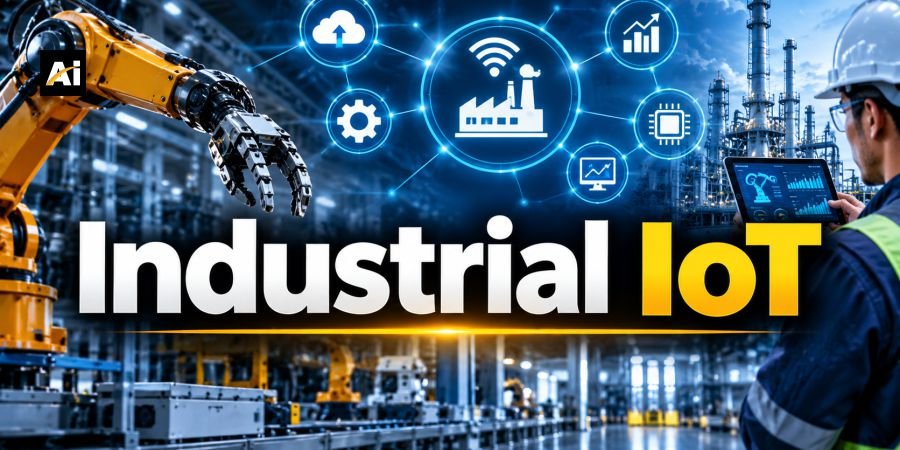
How Industrial IoT Is Building Smarter Factories, Optimizing Operations, and Redefining the Future of Industry
Industries are stepping into a new age of development, where machines, production systems and digital solutions become interlinked. The manufacturers start to go beyond the usual automated process and move to intelligent environments where machinery is connected, the information collected drives decision-making, and manufacturing processes become flexible enough to adjust to new demands.
In the context of this change, there is a concept called Industrial Internet of Things (IIoT). It is a technology-based system, allowing to connect industrial devices, sensors, software platforms, analytics, etc., providing a better environment for operations.
By collecting and analyzing information gathered from machines and manufacturing processes, companies can become more aware of their processes and find areas of improvement.
Turning Industrial Data into Operational Intelligence
Modern factories produce vast amounts of operational data. Differences in temperature, machine performance, energy use, rate of production, and material movement all serve as key indicators of how well an operation is running. Nevertheless, data alone does not become truly useful until organisations learn to transform it into actionable intelligence.
With the help of Industrial IoT, factories gain access to such data by using connected devices and systems. Instead of conducting inspections or creating reports from time to time, production specialists are able to get real-time data about the situation.
Such a strategy will allow for making better decisions and improving coordination among departments and management in order to find out inefficiencies that would otherwise go unnoticed.
Predictive Maintenance and Equipment Reliability
Unplanned machinery breakdowns may lead to disruptions in production plans, incur unnecessary maintenance costs, and impact customer obligations. In general, traditional approaches to maintenance are based on fixed service periods or reactive maintenance after the breakdown. However, both of these options can entail unnecessary costs due to unpredictable changes in the state of equipment.
The connected monitoring system enables a different strategy of dealing with potential problems that might arise during operations. The analysis of vibration, temperature, pressure, working hours, and other characteristics of the equipment can help to detect abnormalities before they escalate into major issues.
In turn, with the help of Industrial IoT, it is possible to shift from preventive maintenance to condition- or predictive-based maintenance of the equipment.
Building Smarter and More Flexible Manufacturing Facilities
Manufacturing systems need to be able to cope with evolving customers’ demands, accelerated product life cycle, and changing demands of the market. The fixed production system may find it difficult to adjust to such challenges, especially if multiple products necessitate different manufacturing processes.
With connected infrastructure in place, the production process becomes much more flexible. Information can be exchanged between machines, manufacturing systems can interact with planning tools, and work flows of production teams can be modified according to current needs.
Industrial Internet of Things combined with robotics, artificial intelligence, and advanced manufacturing software allows for the creation of smarter production facilities. Such technologies can enable automatic quality control, better visibility of the inventory, and more precise planning of production.
The point here is not about introducing more automation. The goal is to develop production systems that would be able to react to changing operational conditions intelligently.
Strengthening Industrial Cybersecurity
Increased connectivity creates new obligations. With industrial systems connected to enterprise networks and external platforms, the risk of being exposed to cyberattacks rises. In the event of an attack targeting production systems, there will be an impact on production activities and confidential data and financial losses for the company.
Thus, organisations should be aware that cybersecurity should become an integral part of the digital transformation process. Network segmentation, access management, device authentication, monitoring, and security evaluations are key elements of a robust industrial environment.
The deployment of IIoT technologies requires special attention to connected devices during the lifecycle of these devices. The manufacturers need to know which systems are interconnected and what data is exchanged and if all connections are compliant with existing security standards.
Cybersecurity enables organisations to develop their technologies and innovations without endangering the operation of critical industrial facilities.
Improving Energy Efficiency and Resource Management
The efficient use of resources and energy has become an important factor for industrial enterprises. Increased cost of operations, environmental accountability, and new regulatory compliance expectations push producers to analyze how effectively they consume electricity, water, raw materials, and other resources.
The use of connected monitoring systems provides detailed data regarding the patterns of consumption in industrial plants. It allows finding the equipment that works inefficiently and analyzing the unnecessary consumption of energy. Moreover, one can assess the influence of operational changes.
Using Industrial IoT, manufacturing companies can achieve a deeper insight into resource consumption on machines, assembly lines, and plants. The obtained information is helpful in planning and helps reduce losses.
This type of approach is especially useful for energy-intensive industries.
Overcoming the Challenges of Industrial Digitalisation
However, adopting connected technologies is not an easy task despite the benefits they offer. Some manufacturers have legacy machinery that was never meant to connect to digital platforms.
High cost, lack of skilled personnel, lack of consistent data standardisation, and cyber security threats are other difficulties associated with adopting connected technologies.
It is necessary to make sure that employees have the knowledge of how to work with operational insights obtained from these technologies and how to apply them in practice.
The process of implementation should start from setting clear business goals. Manufacturers will be able to identify the most important equipment first and then proceed with measurable performance indicators.
As for the results, digital capabilities will gradually grow.
The Road Ahead for Connected Industry
The next stage of industrial evolution will be defined by greater interconnection of connected devices, artificial intelligence, edge computing, robots, and digital twin technology. This technology will help companies to assess their working environment in a much better way and perform simulations before making changes to it physically.
The Industrial Internet of Things will remain a key element in this evolution, providing connectivity between the physical world and digital intelligence. With more advanced platforms available, there will be more ways for manufacturers to enhance manufacturing processes, see how their supply chains function, and cope with any disruptions.
The real value that can be delivered through this technology will not be measured by the amount of connected devices installed in companies’ facilities. It will be about the ability of organizations to use all the information that devices generate and derive benefits from it.
Industrialization is heading toward a world that revolves around connectivity and intelligence being crucial elements of competitiveness. Companies that will merge technology with planning and execution will find it easier to adjust to this shift in the future. Ultimately, the future of manufacturing will belong to those companies that will learn how to leverage their connectivity to become intelligent and successful.