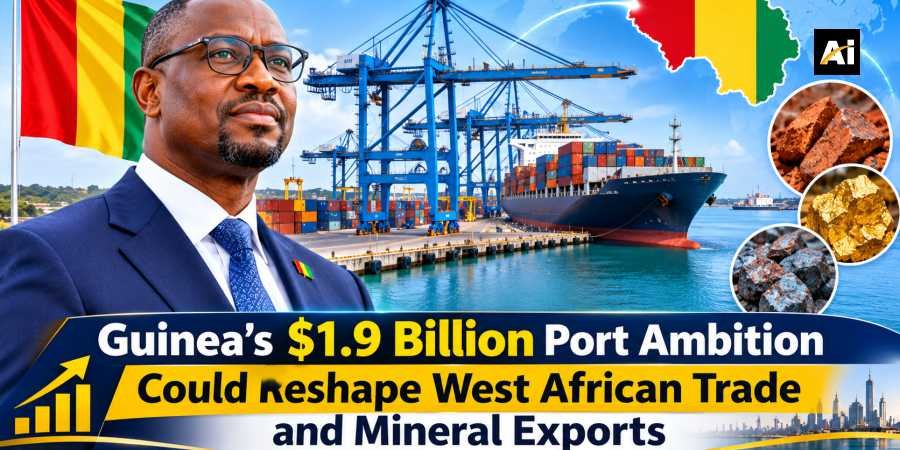
Guinea is now planning to implement a major infrastructure project that would improve its standing in international trade and open up new possibilities for many industries within West Africa. The government plans to finance an estimated $1.9 billion in order to construct a deep water port that will cater to mining firms, ships, and any other businesses.
This comes at a time when Guinea aims to harness maximum economic benefit from its abundance of minerals. The country has established itself as a top producer of bauxite and has gained international recognition through the Simandou iron ore mining operation. Most of its mining infrastructure has however been designed to meet the needs of particular projects, with their own rails and export terminals.
The new port project follows a certain model. Being designed to operate with large ships with capacity of 200,000 tonnes, the port is supposed to export minerals and containers as well as to transport industrial goods. The multi-use feature of the port may provide various companies with an opportunity to use shared infrastructure and to decrease reliance on private export infrastructure.
According to Guinea’s Mines Minister Bouna Sylla, Reuters reported, all feasibility studies have been made and negotiations with possible investors have started. These investors include the US Development Finance Corporation, Chinese investors, the World Bank, the African Development Bank, Africa Finance Corporation and the International Finance Corporation. Up until November 16, there was no information about choosing the investors and construction schedule.
In the broader context, increased port capacity will enable the trading of goods not only from the mining sector, but for other purposes as well. Increased access to the sea will allow manufacturers to import machinery and products, export their products to international customers and provide logistics companies with further services. The establishment of such a complex could also promote investments in the sectors of warehousing, transportation, processing, etc.
Despite that, the financial feasibility of the project will also depend on the factors other than the construction. Transport accessibility of the area, clear access policy and the investment-friendly environment created by Guinea should be developed. Moreover, the volume of cargo that would be transported through the port will have to prove its viability from the economic perspective.
The issue of financing the project would also have to be addressed.
The proposal offers Guinea an invaluable chance to escape from being a nation which exports its natural resources without any industrialization by means of separate infrastructure systems. When put into effect properly, the port will be able to become a collective economic resource